January 10, 2026

Contractor Kartavya’s Conundrum / Ekalavya’s Excursions

 I’ve gone through your uploaded handwritten notes (the “Contractor Kartavya’s Conundrum / Ekalavya’s Excursions” material) and distilled them into two clean outputs:

  1. Structured study notes (crisp, exam/learning-friendly)

  2. A conceptual blog post (story-driven, intuitive, readable)

Both are derived directly from the content in the PDF, especially pages 1–5 and the later linear algebra sections on functions, matrices, inverses, and transformations .


1. Clean Notes (Structured)

Theme 1: Contractor Kartavya’s Conundrum

Problem statement

  • Kartavya wants to determine the optimal statewise distribution of workers to maximize productivity.

  • Parameters:

    • ( k = 120 ) months

    • ( n = 30 ) states

  • Productivity over time is modeled using a system of linear equations:
    [
    \begin{aligned}
    a_{11}s_1 + a_{12}s_2 + \dots + a_{1n}s_n &= P_1 \
    a_{21}s_1 + a_{22}s_2 + \dots + a_{2n}s_n &= P_2 \
    \vdots \
    a_{k1}s_1 + a_{k2}s_2 + \dots + a_{kn}s_n &= P_k
    \end{aligned}
    ]

Key idea


Theme 2: Outsourcing as Optimization

How Kartavya outsources

  1. Defines an error function

  2. Uses an iterative method metaphorically called
    “Blind man’s walk down the hill”

    • Intuition for gradient descent

    • Move step-by-step in the direction that reduces error

Insight

  • Even without deep math, arithmetic + iteration can converge to good solutions


Theme 3: Functions and Inverses (Ekalavya’s Excursions)

Scalar Functions

  • Example:
    [
    f(x) = x^2 \Rightarrow f^{-1}(y) = \sqrt{y}
    ]

  • Understanding a function deeply allows construction of its inverse


Theme 4: Matrices as Functions

A matrix behaves like a function mapping vectors to vectors.

Example:
[
f:
\begin{pmatrix}
x \ y
\end{pmatrix}
\mapsto
\begin{pmatrix}
2x + y \
x + 3y
\end{pmatrix}
]

  • This is a function ( f: \mathbb{R}^2 \to \mathbb{R}^2 )

  • Question: Is it invertible?


Theme 5: Finding the Inverse (Hook or Crook)

Solve:
[
\begin{cases}
2\alpha + \beta = a \
\alpha + 3\beta = b
\end{cases}
]

Solution:
[
\begin{pmatrix}
\alpha \
\beta
\end{pmatrix}

\begin{pmatrix}
\frac{3a-b}{5} \
\frac{2b-a}{5}
\end{pmatrix}
]

Matrix inverse:
[
\begin{pmatrix}
2 & 1 \
1 & 3
\end{pmatrix}^{-1}

\begin{pmatrix}
\frac{3}{5} & -\frac{1}{5} \
-\frac{1}{5} & \frac{2}{5}
\end{pmatrix}
]


Theme 6: Linear Combinations & Span

  • Any point in the plane can be written as:
    [
    \alpha u + \beta v
    ]

  • If vectors (u, v) are linearly independent → mapping is 1–1 and onto


Theme 7: Composition of Linear Maps

If:
[
f(x,y) = (2x+y,\ x+3y)
]
[
g(a,b) = (a+b,\ 4a+5b)
]

Then:
[
g(f(x,y)) = (3x+4y,\ 13x+19y)
]

➡️ Composition corresponds to matrix multiplication


Theme 8: Geometric Transformations

  • Rotation by 90° clockwise:
    [
    \begin{pmatrix}
    0 & 1 \
    -1 & 0
    \end{pmatrix}
    ]

  • Reflections and rotations are also linear transformations

  • Geometry ↔ algebra via matrices


2. Blog Post (Conceptual & Story-Driven)

From Blind Walks to Brilliant Solutions: How Linear Algebra Explains Learning

Kartavya isn’t a mathematician. He’s a contractor with a problem.

He has workers scattered across 30 states and productivity data spanning 120 months. The question haunting him is deceptively simple:

How should I distribute my workers so productivity is maximized?

Behind the scenes, this is a massive system of equations—far too complex to solve by hand. So Kartavya does something radical.

He outsources thinking itself.


Learning Without Knowing the Math

Kartavya defines an error—how far reality is from what he wants. Then he lets the town try random steps, keeping only those that reduce the error.

It’s like a blindfolded person walking downhill, step by step.

You already know this idea by another name: gradient descent.

Learning, it turns out, doesn’t require genius—just feedback and direction.


Ekalavya’s Real Lesson

Ekalavya asks a deeper question: What does it mean to reverse a process?

If squaring turns 3 into 9, what turns 9 back into 3?

This curiosity leads us from simple functions to matrices—objects that don’t just compute numbers, but move space itself.


Matrices Are Functions in Disguise

A matrix isn’t just numbers in a box. It’s a function:

  • It takes a point

  • Moves it

  • Stretches it

  • Rotates it

  • Or flips it

And sometimes—if you’re lucky—you can undo it perfectly.

That’s what an inverse really is:
A guarantee that no information was lost.


Why This Matters

  • Machine learning is just Kartavya’s outsourcing, scaled up

  • Neural networks are stacked matrix functions

  • Invertibility is about reversibility and trust

  • Geometry, algebra, and optimization are the same story told differently


Final Thought

Math isn’t about symbols.

It’s about control:

  • Can you predict?

  • Can you reverse?

  • Can you improve step by step?

Kartavya didn’t learn linear algebra.

Linear algebra learned Kartavya.


If you want, I can:

  • Turn this into LaTeX notes

  • Simplify it for high-school / JEE / undergrad

  • Convert the blog into Medium / Substack style

  • Add visual explanations or diagrams

Just tell me how you want to use it.

Finding Top-K Frequent Elements in Java: From Interview Solution to Production-Ready Code

Finding the top-K most frequent elements is a classic interview problem that looks simple—but is often used to evaluate how well a candidate understands time complexity, space optimization, and scalability trade-offs.

In this post, we’ll start with a common interview solution, analyze its shortcomings, and progressively evolve it into optimal and scalable approaches suitable for real-world systems.


Problem Statement

Given a list of strings, return the top K most frequent strings.

Example:

Input: ["def","abc","def","abc","def","ghi"]
K = 3
Output: def, abc, ghi

Baseline Interview Solution (Max Heap)

A very common approach is:

  1. Count frequencies using a HashMap

  2. Push all unique keys into a max-heap

  3. Poll k elements

Code

Map<String, Integer> map = new HashMap<>();
for (String s : list) {
    map.put(s, map.getOrDefault(s, 0) + 1);
}

PriorityQueue<String> pq =
    new PriorityQueue<>((a, b) -> map.get(b) - map.get(a));

pq.addAll(map.keySet());

for (int i = 0; i < k; i++) {
    System.out.println(pq.poll());
}

Complexity Analysis (Corrected)

Let:

  • N = total number of elements

  • U = number of unique elements

StepComplexity
Frequency countO(N)
Heap buildO(U log U)
Extract top KO(k log U)
SpaceO(U)

What Interviewers Notice

  • Heap size grows to all unique elements

  • Comparator uses subtraction → integer overflow risk

  • Inefficient when k is small and U is large


Improvement #1: Fix Comparator Overflow

This line is dangerous:

(a, b) -> map.get(b) - map.get(a)

If counts are large, subtraction can overflow.

Safer Version

(a, b) -> Integer.compare(map.get(b), map.get(a))

This is a frequent interview pitfall.


Improvement #2: Use a Min-Heap of Size K (Optimal)

Instead of storing all unique elements, we only keep the top K seen so far.

Key Idea

  • Use a min-heap

  • Remove smallest frequency whenever size exceeds k

Optimized Code

Map<String, Integer> freq = new HashMap<>();
for (String s : list) {
    freq.put(s, freq.getOrDefault(s, 0) + 1);
}

PriorityQueue<String> pq =
    new PriorityQueue<>((a, b) ->
        Integer.compare(freq.get(a), freq.get(b))
    );

for (String key : freq.keySet()) {
    pq.offer(key);
    if (pq.size() > k) {
        pq.poll();
    }
}

while (!pq.isEmpty()) {
    System.out.println(pq.poll());
}

Complexity

MetricValue
TimeO(N + U log K)
SpaceO(U + K)

This is the preferred interview solution.


Improvement #3: Avoid Repeated Map Lookups

A more efficient and cleaner approach is to store Map.Entry objects directly.

PriorityQueue<Map.Entry<String, Integer>> pq =
    new PriorityQueue<>(
        (a, b) -> Integer.compare(a.getValue(), b.getValue())
    );

for (Map.Entry<String, Integer> entry : freq.entrySet()) {
    pq.offer(entry);
    if (pq.size() > k) {
        pq.poll();
    }
}

while (!pq.isEmpty()) {
    System.out.println(pq.poll().getKey());
}

This reduces repeated hash lookups and improves readability.


Improvement #4: Bucket Sort (When Counts Are Bounded)

If frequencies are bounded by N, we can eliminate heap usage entirely.

Idea

  • Create buckets where index = frequency

  • Traverse from highest frequency down

Complexity

  • Time: O(N + U)

  • Space: O(N)

This is usually mentioned verbally in interviews to demonstrate algorithmic range.


Handling Massive Data (1B+ Records)

For very large datasets:

  • Holding all strings in memory is not feasible

  • HashMap alone can exhaust heap

Real-World Approach

Mentioning this shows system design awareness, not just coding skill.


Key Interview Takeaways

What this problem really tests:


Final Thoughts

A solution that works is not the same as a solution that scales.

If you can:

  • Start with the basic heap

  • Optimize to O(U log K)

  • Discuss bucket sort and streaming

You’ll stand out as someone who writes production-grade code, not just interview code.


If you want, I can:

Just say the word.

January 9, 2026

Finding Engaged Users From Interaction Logs: What I Learned Building It in Java 7, 8, and 17

When you’re given raw interaction events like:

Timestamp,UserId,PostId

…and asked to derive a meaningful cohort (in this case, “engaged users”), the challenge is rarely the syntax. The challenge is choosing the right data structures, keeping the logic correct, and writing code that’s easy to explain in an interview.

This post walks through the core idea, common mistakes, and clean implementations in Java 7, Java 8, and Java 17.


The Problem

You have two days of interaction logs. A user is considered engaged if:

  1. They have at least one interaction on both days, and

  2. Across both days combined, they interacted with at least two unique posts.

Important detail: multiple interactions with the same post count only once toward “unique posts”.


The Core Insight

This is a “group-by user” problem with two checks:

  • Presence on day 1 and day 2

  • Unique post count across both days

The simplest and most reliable approach is:

  • Use a Map keyed by userId.

  • Store post IDs in Sets (because uniqueness is built-in).

Why sets are the right tool

If you store post IDs in a list, you’ll need extra de-dup logic. With sets:

  • Add is O(1) average

  • Uniqueness is automatic


A Simple Data Model

For two days, a lightweight per-user structure is enough:

  • Set<String> day1Posts

  • Set<String> day2Posts

A user qualifies if both sets are non-empty and the union size is ≥ 2.


Common Mistakes (The Ones That Usually Show Up in Interviews)

1) Using counts instead of presence

You only need to know whether the user appeared that day (at least one event). Counting events adds complexity with no benefit unless the requirements change.

2) Mixing mutation inside filtering predicates

Using removeIf(...) or stream filter(...) to also mutate sets is a readability and correctness trap.

Predicates should return a boolean and avoid side effects.

3) Java version mismatch

  • Java 8 streams do not have .toList(). Use collect(Collectors.toList()).

  • Java 17 streams do have .toList().

4) Splitting each log line multiple times

Calling log.split(",") repeatedly creates garbage and slows things down. Parse once per line.


Example Input Used Throughout

// Day 1
"2026-01-01T10:05:12Z,U1,P101"
"2026-01-01T10:07:45Z,U2,P102"
"2026-01-01T10:10:30Z,U1,P103"
"2026-01-01T10:15:00Z,U3,P104"

// Day 2
"2026-01-02T09:00:10Z,U1,P101"
"2026-01-02T09:05:20Z,U2,P105"
"2026-01-02T09:10:55Z,U4,P106"
"2026-01-02T09:12:00Z,U2,P102"

Expected engaged users: [U1, U2] (order doesn’t matter)


Java 7 Implementation (Imperative, Clear, Interview-Friendly)

Java 7 has no streams/lambdas, so we use plain loops.

import java.util.*;

public class EngagedUsersFinderJava7 {

    private static final List<String> DAY1_LOGS = Arrays.asList(
        "2026-01-01T10:05:12Z,U1,P101",
        "2026-01-01T10:07:45Z,U2,P102",
        "2026-01-01T10:10:30Z,U1,P103",
        "2026-01-01T10:15:00Z,U3,P104"
    );

    private static final List<String> DAY2_LOGS = Arrays.asList(
        "2026-01-02T09:00:10Z,U1,P101",
        "2026-01-02T09:05:20Z,U2,P105",
        "2026-01-02T09:10:55Z,U4,P106",
        "2026-01-02T09:12:00Z,U2,P102"
    );

    static class Engage {
        final String userId;
        final Set<String> day1Posts = new HashSet<String>();
        final Set<String> day2Posts = new HashSet<String>();

        Engage(String userId) {
            this.userId = userId;
        }
    }

    public static List<String> findEngagedUsers() {
        Map<String, Engage> userMap = new HashMap<String, Engage>();

        // Day 1
        for (String log : DAY1_LOGS) {
            String[] parts = log.split(",");
            String userId = parts[1];
            String postId = parts[2];

            Engage e = userMap.get(userId);
            if (e == null) {
                e = new Engage(userId);
                userMap.put(userId, e);
            }
            e.day1Posts.add(postId);
        }

        // Day 2
        for (String log : DAY2_LOGS) {
            String[] parts = log.split(",");
            String userId = parts[1];
            String postId = parts[2];

            Engage e = userMap.get(userId);
            if (e == null) {
                e = new Engage(userId);
                userMap.put(userId, e);
            }
            e.day2Posts.add(postId);
        }

        // Filter engaged
        List<String> result = new ArrayList<String>();
        for (Engage e : userMap.values()) {
            if (!e.day1Posts.isEmpty() && !e.day2Posts.isEmpty()) {
                Set<String> union = new HashSet<String>(e.day1Posts);
                union.addAll(e.day2Posts);
                if (union.size() >= 2) {
                    result.add(e.userId);
                }
            }
        }
        return result;
    }

    public static void main(String[] args) {
        System.out.println(findEngagedUsers());
    }
}

Java 8 Implementation (Streams for Filtering)

Java 8 adds streams and lambdas, which can make the filtering phase more declarative.

Important: use collect(Collectors.toList()) in Java 8.

import java.util.*;
import java.util.stream.Collectors;

public class EngagedUsersFinderJava8 {

    private static final List<String> DAY1_LOGS = Arrays.asList(
        "2026-01-01T10:05:12Z,U1,P101",
        "2026-01-01T10:07:45Z,U2,P102",
        "2026-01-01T10:10:30Z,U1,P103",
        "2026-01-01T10:15:00Z,U3,P104"
    );

    private static final List<String> DAY2_LOGS = Arrays.asList(
        "2026-01-02T09:00:10Z,U1,P101",
        "2026-01-02T09:05:20Z,U2,P105",
        "2026-01-02T09:10:55Z,U4,P106",
        "2026-01-02T09:12:00Z,U2,P102"
    );

    static class Engage {
        final String userId;
        final Set<String> day1Posts = new HashSet<>();
        final Set<String> day2Posts = new HashSet<>();

        Engage(String userId) {
            this.userId = userId;
        }
    }

    public static List<String> findEngagedUsers() {
        Map<String, Engage> userMap = new HashMap<>();

        for (String log : DAY1_LOGS) {
            String[] parts = log.split(",");
            String userId = parts[1];
            String postId = parts[2];

            Engage e = userMap.get(userId);
            if (e == null) {
                e = new Engage(userId);
                userMap.put(userId, e);
            }
            e.day1Posts.add(postId);
        }

        for (String log : DAY2_LOGS) {
            String[] parts = log.split(",");
            String userId = parts[1];
            String postId = parts[2];

            Engage e = userMap.get(userId);
            if (e == null) {
                e = new Engage(userId);
                userMap.put(userId, e);
            }
            e.day2Posts.add(postId);
        }

        return userMap.values().stream()
            .filter(e -> !e.day1Posts.isEmpty() && !e.day2Posts.isEmpty())
            .filter(e -> {
                Set<String> union = new HashSet<>(e.day1Posts);
                union.addAll(e.day2Posts);
                return union.size() >= 2;
            })
            .map(e -> e.userId)
            .collect(Collectors.toList());
    }

    public static void main(String[] args) {
        System.out.println(findEngagedUsers());
    }
}

Java 17 Implementation (Records + Modern Conveniences)

Java 17 lets you write concise, expressive code:

  • record for modeling

  • List.of(...) for input lists

  • Stream.toList() for collection

import java.util.*;
import java.util.stream.Stream;

public class EngagedUsersFinderJava17 {

    private static final List<String> DAY1_LOGS = List.of(
        "2026-01-01T10:05:12Z,U1,P101",
        "2026-01-01T10:07:45Z,U2,P102",
        "2026-01-01T10:10:30Z,U1,P103",
        "2026-01-01T10:15:00Z,U3,P104"
    );

    private static final List<String> DAY2_LOGS = List.of(
        "2026-01-02T09:00:10Z,U1,P101",
        "2026-01-02T09:05:20Z,U2,P105",
        "2026-01-02T09:10:55Z,U4,P106",
        "2026-01-02T09:12:00Z,U2,P102"
    );

    record Engage(String userId, Set<String> day1Posts, Set<String> day2Posts) {
        Engage(String userId) {
            this(userId, new HashSet<>(), new HashSet<>());
        }
    }

    public static List<String> findEngagedUsers() {
        Map<String, Engage> userMap = new HashMap<>();

        DAY1_LOGS.forEach(log -> {
            var parts = log.split(",");
            userMap.computeIfAbsent(parts[1], Engage::new).day1Posts().add(parts[2]);
        });

        DAY2_LOGS.forEach(log -> {
            var parts = log.split(",");
            userMap.computeIfAbsent(parts[1], Engage::new).day2Posts().add(parts[2]);
        });

        return userMap.values().stream()
            .filter(e -> !e.day1Posts().isEmpty() && !e.day2Posts().isEmpty())
            .filter(e ->
                Stream.concat(e.day1Posts().stream(), e.day2Posts().stream())
                      .distinct()
                      .count() >= 2
            )
            .map(Engage::userId)
            .toList();
    }

    public static void main(String[] args) {
        System.out.println(findEngagedUsers());
    }
}

A quick note: the record holds mutable sets here. That’s fine for a coding exercise, but in production you’d typically prefer immutability (or keep it as a normal class with encapsulation).


Complexity (What You Should Say Out Loud)

Let:

  • N = number of events on day 1

  • M = number of events on day 2

Time Complexity: O(N + M)
Space Complexity: O(U + P)
(where U is number of users and P is total unique user-post relationships)


How to Explain the Approach in an Interview (A Strong Script)

Here’s a concise explanation that typically lands well:

“I group events by user. For each user I track unique post IDs for each day using sets.
Then I filter users who appear on both days and whose union of post IDs across the two days contains at least two unique posts.
Sets give me uniqueness for free, and the solution is linear in the size of the logs.”


Extensions That Make Great Follow-Ups

1) More than two days

Replace day-specific fields with:

  • Set<LocalDate> activeDays, or

  • BitSet / bitmask if the day count is bounded, or

  • Map<Day, Set<Post>> if you want to keep per-day post sets

2) Huge log files

Process logs line-by-line with BufferedReader, avoid loading everything in memory. The same data structures still work.

3) Malformed lines

Add validation around split length and skip/record bad lines.


Final Takeaways

  • Sets are the simplest way to enforce uniqueness.

  • Separate aggregation from filtering.

  • Be mindful of Java version APIs (toList() vs Collectors.toList()).

  • Clean naming (day1Posts, not day1Users) makes your reasoning easier to follow.

  • The best interview solutions are not the “cleverest”—they’re the clearest.

If you want, I can turn this into a “publish-ready” Medium-style post (with headings, diagrams, and a “what the interviewer is looking for” rubric) or add a JUnit test section for each Java version.

October 1, 2025

๐Ÿš€ Finding the Length of the Longest Substring Without Repeating Characters

When preparing for interviews or working with string algorithms, one classic problem is:

Given a string s, return the length of the longest substring without repeating characters.

Example:

  • Input: "abcabcbb"

  • Output: 3 (because "abc" is the longest substring without repeating chars)


๐Ÿงฉ Problem Intuition

We want the longest contiguous substring where no character repeats.
Naively, we could try every substring (O(n²)) and check uniqueness, but that’s too slow for larger inputs.

Instead, we use a sliding window:

  • Expand the right boundary to include characters.

  • If a duplicate appears, shrink the left boundary until the window is valid again.

  • Track the maximum length as we go.


๐Ÿ› ️ Sliding Window + Hashing Approach

Core Ideas:

  1. Maintain two pointers: l (left) and r (right).

  2. Keep a map of last-seen indices of each character.

  3. For each character at r:

    • If it’s already in the current window (map[ch] >= l), move l to map[ch] + 1.

    • Update the last-seen index of ch.

    • Update the max length.

This ensures each character is processed at most twice (once when r expands, once when l moves), giving us O(n) time.


๐Ÿ’ป Java Implementation

import java.util.Arrays;

class Solution {
    public int lengthOfLongestSubstring(String s) {
        int l = 0, r = 0;
        int[] map = new int[256]; // supports ASCII
        Arrays.fill(map, -1);

        int maxLen = 0;
        while (r < s.length()) {
            char ch = s.charAt(r);

            // if char seen in current window, move left pointer
            if (map[ch] >= l) {
                l = map[ch] + 1;
            }

            // update window
            map[ch] = r;
            maxLen = Math.max(maxLen, r - l + 1);

            r++;
        }
        return maxLen;
    }
}

๐Ÿ“Š Complexity Analysis

  • Time Complexity: O(n) → each character visited at most twice.

  • Space Complexity: O(1) → fixed-size array (256) for ASCII.
    For Unicode, switch to HashMap<Character,Integer>.


๐Ÿ”‘ Key Takeaways

  • Sliding window problems often involve two pointers and a hash structure.

  • Always update your left pointer only when duplicates fall inside the current window.

  • This problem demonstrates the balance between correctness and efficiency — no need to brute force!


✅ Next step: try extending this logic to variations like:

  • Longest substring with at most k distinct characters

  • Longest substring where characters can repeat up to m times


September 25, 2025

Building Water with Multithreading in Java: H2O Problem Explained

Introduction

Multithreading is one of the core concepts in computer programming where multiple threads run concurrently. Synchronizing these threads is crucial to avoid race conditions and ensure proper execution order.

A popular interview problem in this domain is the H2O problem, where the goal is to simulate the formation of water molecules using threads.


Problem Statement

We have two types of threads:

  • Hydrogen threads (H)

  • Oxygen threads (O)

The goal is to form water molecules (H₂O), which means each water molecule requires exactly 2 hydrogen threads and 1 oxygen thread.

The constraints are:

  1. No thread can “bond” until a complete molecule can form.

  2. Threads must pass the barrier in groups of three (2H + 1O).

  3. Threads from one molecule must bond before threads from the next molecule can start.

Essentially, we need synchronization to make sure water molecules are formed correctly in a multithreaded environment.


Intuition Behind the Solution

Think of this as a barrier problem:

  • We have hydrogen threads and oxygen threads arriving randomly.

  • A hydrogen thread must wait if there isn’t an oxygen thread and another hydrogen thread available.

  • An oxygen thread must wait if there aren’t two hydrogen threads available.

  • Once a complete molecule is ready (1 O + 2 H), all three threads “bond” together.

We can solve this using semaphores and barriers.


Key Concepts Used

1. Semaphore

A semaphore is a thread synchronization tool that allows a limited number of threads to access a resource at the same time.

  • Semaphore(n) allows n threads to acquire permits.

  • acquire() reduces the available permits.

  • release() increases the available permits.

In this problem:

  • Hydrogen semaphore allows 2 permits (max 2 H threads per molecule).

  • Oxygen semaphore allows 1 permit (max 1 O thread per molecule).


2. CyclicBarrier

A CyclicBarrier is a synchronization aid that allows a set of threads to wait for each other.

  • Once the required number of threads reach the barrier, all are released simultaneously.

  • Here, we use CyclicBarrier(3) because a molecule requires 3 threads (2 H + 1 O).


Step-by-Step Solution

Here’s the code:

import java.util.concurrent.Semaphore;
import java.util.concurrent.CyclicBarrier;

class H2O {

    private Semaphore hydrogenSemaphore;
    private Semaphore oxygenSemaphore;
    private CyclicBarrier barrier;

    public H2O() {
        hydrogenSemaphore = new Semaphore(2); // max 2 hydrogen threads
        oxygenSemaphore = new Semaphore(1);   // max 1 oxygen thread
        barrier = new CyclicBarrier(3);       // wait for 3 threads to form a molecule
    }

    public void hydrogen(Runnable releaseHydrogen) throws InterruptedException {
        hydrogenSemaphore.acquire(); // acquire hydrogen slot

        try {
            barrier.await();  // wait until a molecule can form
        } catch (Exception e) {
            e.printStackTrace();
        }

        releaseHydrogen.run();  // release hydrogen (print H)
        hydrogenSemaphore.release(); // free hydrogen slot
    }

    public void oxygen(Runnable releaseOxygen) throws InterruptedException {
        oxygenSemaphore.acquire(); // acquire oxygen slot

        try {
            barrier.await(); // wait until 2 hydrogens are available
        } catch (Exception e) {
            e.printStackTrace();
        }

        releaseOxygen.run();  // release oxygen (print O)
        oxygenSemaphore.release(); // free oxygen slot
    }
}

How the Solution Works

  1. Hydrogen Threads:

    • Acquire a hydrogen permit.

    • Wait at the CyclicBarrier until 1 oxygen + 1 more hydrogen arrive.

    • Once all 3 threads arrive, the barrier releases them simultaneously.

  2. Oxygen Threads:

    • Acquire an oxygen permit.

    • Wait at the CyclicBarrier until 2 hydrogen threads arrive.

    • Once the barrier is complete, the oxygen and two hydrogen threads bond.

  3. Guarantees:

    • No partial molecule formation: threads wait at the barrier.

    • Threads from the next molecule don’t proceed until the current molecule completes.

    • Correct number of threads per molecule due to semaphores.


Example Output

If threads arrive in the order H H O H H O:

H H O H H O

This is valid because every 3 threads form a molecule.


Why This Approach Works

  • Semaphores control the maximum number of hydrogen and oxygen threads per molecule.

  • CyclicBarrier ensures all threads wait until a complete molecule is ready.

  • This combination guarantees safe and correct synchronization.

Alternative approaches might use locks + condition variables, but semaphores + barrier is simpler and cleaner.


Key Takeaways

  1. Think in terms of resources and limits: hydrogen and oxygen slots.

  2. Use a barrier for group synchronization: wait until all threads needed for a molecule arrive.

  3. Ensure atomic molecule formation: threads from one molecule must bond together before next molecule forms.

  4. This pattern is useful for thread grouping problems in general, not just H2O.


This approach is easy to learn, scalable, and safe for multithreading.


If you want, I can also make a visual diagram showing how threads wait at the barrier and release—this makes it even easier to understand.

Do you want me to make that diagram?

September 5, 2025

๐Ÿ”น Finding the First Equilibrium Point in an Array

When solving coding problems, one frequently encountered challenge is finding the equilibrium point in an array. This is a classical problem in algorithm design that tests the ability to balance sums efficiently without resorting to brute force. Let’s break it down in detail.


๐Ÿ“Œ Problem Statement

Given an array A of n non-negative integers, the task is to find the first equilibrium point. An equilibrium point is an index such that the sum of elements before it is equal to the sum of elements after it.

  • Use 1-based indexing.

  • If no equilibrium point exists, return -1.

Constraints:

  • 1 <= n <= 10^5

  • 0 <= A[i] <= 10^9


๐Ÿ”Ž Examples

Example 1

Input:

n = 5
A[] = {1, 3, 5, 2, 2}

Process:

  • Index 1 → Left sum = 0, Right sum = 12 ❌

  • Index 2 → Left sum = 1, Right sum = 9 ❌

  • Index 3 → Left sum = 4, Right sum = 4 ✅

Output:

3

Example 2

Input:

n = 1
A[] = {1}

Since there’s only one element, it automatically becomes the equilibrium point.

Output:

1

⚡ Why Brute Force Fails

A naรฏve approach would be:

  • For each index i, compute sum of elements before and after it.

  • Compare the two.

This requires O(n²) time in the worst case, which is inefficient for large inputs (n ≤ 100,000). Hence, we need a more optimized approach.


✅ Optimized Approaches

1. Total Sum & Left Sum Method (Efficient Approach)

We can achieve O(n) time and O(1) space using the following idea:

  1. Compute the total sum of the array.

  2. Traverse through the array while maintaining a left sum.

  3. At each index i, check:

    leftSum == totalSum - leftSum - A[i]
    

    If true, this is the equilibrium point.

  4. Update leftSum += A[i] and continue.


2. Prefix Sum Approach

Another approach uses prefix sums to quickly compute left and right sums:

  1. Create an array prefix[] where prefix[i] stores the sum of elements from 0 to i.

  2. For each index i, left sum = prefix[i-1], right sum = prefix[n-1] - prefix[i].

  3. If left sum == right sum → equilibrium found.

Complexity:

  • Time Complexity: O(n) (one pass to compute prefix, one pass to check).

  • Space Complexity: O(n) (extra array for prefix sums).

This approach is less space-efficient than the total sum method, but conceptually easier to understand.


๐Ÿง‘‍๐Ÿ’ป Implementation (Java - Total Sum Method)

class Solution {
    public static int equilibriumPoint(long arr[], int n) {
        long totalSum = 0, leftSum = 0;

        // Step 1: Find total sum
        for (int i = 0; i < n; i++) {
            totalSum += arr[i];
        }

        // Step 2: Traverse and check equilibrium condition
        for (int i = 0; i < n; i++) {
            totalSum -= arr[i]; // totalSum now acts as rightSum

            if (leftSum == totalSum) {
                return i + 1; // 1-based index
            }

            leftSum += arr[i];
        }

        return -1; // No equilibrium point found
    }
}

๐Ÿง‘‍๐Ÿ’ป Implementation (Python - Prefix Sum Method)

def equilibriumPoint(arr, n):
    prefix = [0] * n
    prefix[0] = arr[0]

    # Build prefix sum array
    for i in range(1, n):
        prefix[i] = prefix[i-1] + arr[i]

    total_sum = prefix[-1]

    for i in range(n):
        left_sum = prefix[i-1] if i > 0 else 0
        right_sum = total_sum - prefix[i]
        
        if left_sum == right_sum:
            return i + 1  # 1-based index

    return -1

๐Ÿ•’ Complexity Analysis

Total Sum Method

  • Time Complexity: O(n)

  • Space Complexity: O(1)

Prefix Sum Method

  • Time Complexity: O(n)

  • Space Complexity: O(n)

Both are efficient, but the Total Sum Method is preferred due to lower space usage.


๐ŸŽฏ Key Observations

  1. The equilibrium point is essentially a balance point.

  2. Total sum helps avoid recomputation of right sums.

  3. Prefix sums provide an intuitive way to check but need extra space.

  4. Works efficiently under given constraints.


๐Ÿ“Œ Applications

  • Load balancing: Splitting workloads evenly.

  • Financial analysis: Checking balance points in profit/loss arrays.

  • Partitioning problems: Finding equal subarray sums.


๐Ÿš€ Conclusion

The equilibrium point problem highlights the power of prefix sums and optimized linear scanning. While prefix sums provide clarity, the total sum + left sum approach is the most space-efficient. By reducing unnecessary recalculations, we turn an O(n²) problem into an O(n) one, making it highly useful in interviews and real-world applications.


September 1, 2025

Find the Second Largest Distinct Element in an Array

When working with arrays, one common interview question is finding the second largest distinct element. Unlike just sorting the array, we want an efficient solution with O(N) time complexity and O(1) space complexity.

Let’s carefully break down the problem.


Problem Statement

You are given an array Arr of size N. You need to print the second largest distinct element in the array.

  • If the second largest element doesn’t exist (all elements are the same), return -1.


Example 1

Input:

N = 6
Arr[] = {12, 35, 1, 10, 34, 1}

Output:

34

Explanation:

  • Largest element = 35

  • Second largest element = 34


Example 2

Input:

N = 3
Arr[] = {10, 5, 10}

Output:

5

Explanation:

  • Largest element = 10

  • Second largest distinct element = 5


Constraints

  • 2 ≤ N ≤ 10^5

  • 1 ≤ Arr[i] ≤ 10^5


Naive Approach (Sorting)

The simplest approach would be:

  1. Sort the array in descending order.

  2. Pick the first element as the largest.

  3. Find the next distinct element as the second largest.

But sorting takes O(N log N), which is not optimal when N can go up to 10^5.


Optimal Approach (Single Pass - O(N))

We can solve this in just one pass:

  1. Maintain two variables:

    • first → largest element

    • second → second largest element

  2. Traverse the array:

    • If arr[i] > first: update second = first and first = arr[i].

    • Else if arr[i] > second and arr[i] != first: update second = arr[i].

  3. At the end:

    • If second is still -1, return -1.


Implementation (Java)

class Solution {
    int print2largest(int arr[], int n) {
        int first = -1, second = -1;
        
        for (int i = 0; i < n; i++) {
            if (arr[i] > first) {
                second = first;
                first = arr[i];
            } else if (arr[i] > second && arr[i] != first) {
                second = arr[i];
            }
        }
        
        return second;
    }
}

Dry Run Example

Input: Arr[] = {12, 35, 1, 10, 34, 1}

  • Start: first = -1, second = -1

  • 12: first = 12, second = -1

  • 35: first = 35, second = 12

  • 1: no update

  • 10: second = 12 → stays

  • 34: second = 34 (since 34 < 35 but > 12)

  • 1: no update

Answer = 34 ✅


Key Takeaways

  • Time Complexity: O(N) → Single traversal.

  • Space Complexity: O(1) → Only two variables used.

  • Works for large arrays efficiently.


Common Mistakes

  1. Forgetting to check for distinctness (e.g., {10, 10, 10} should return -1).

  2. Not updating the second properly when a new first is found.

  3. Returning the same value as largest when all elements are equal.


Final Words

This is a classic array problem that helps you think about tracking multiple values in one pass without sorting. It’s a great stepping stone to more advanced interview questions where optimization matters.

๐Ÿ‘‰ If you’ve understood this, try extending the idea to find the third largest distinct element in an array!


Would you like me to also write the Python version of this solution for your blog readers who might prefer Python over Java?

August 30, 2025

๐Ÿงฉ Alice and Bob’s Binary Game — Full Intuition Walkthrough

Welcome to today’s blog! Let’s solve an interesting coding problem step by step, with full intuition, question details, and multiple solutions. This post is designed like a work-class learning blog so that even freshers can follow easily.


❓ The Question

There are two friends — Alice and Bob. They love binary numbers, but in different ways:

  • Alice loves set bits at even positions (positions 0,2,4,… from the right).

  • Bob loves set bits at odd positions (positions 1,3,5,…).

For a given number N:

  • Each set bit contributes its value as 2^position.

  • Alice sums values at even positions.

  • Bob sums values at odd positions.

  • Finally, we calculate the absolute difference between Alice’s and Bob’s scores.

Constraints

  • 0 ≤ N ≤ 10^18

  • Expected Time Complexity: O(log N)

  • Expected Space Complexity: O(1)

Example 1

Input: N = 13
Binary: 1101

  • Alice: (positions 0,2) → 1 + 4 = 5

  • Bob: (position 3) → 8
    Output: |5 - 8| = 3

Example 2

Input: N = 42
Binary: 101010

  • Alice: (even positions) = 0

  • Bob: (positions 1,3,5) → 2 + 8 + 32 = 42
    Output: |0 - 42| = 42


๐Ÿ” Step-by-Step Intuition

The game is just about splitting binary bits into two groups:

  • Even bits → Alice

  • Odd bits → Bob

Then, sum their values and take the difference.

Think of it like sorting coins into two baskets — one basket for Alice (even slots), another for Bob (odd slots).


๐Ÿฅ‡ Solution 1: Bit-by-Bit Approach (For Freshers)

This solution mimics the game directly:

  1. Start at the least significant bit (position 0).

  2. Check if the bit is set.

  3. Add it to Alice’s or Bob’s total based on position.

  4. Move to the next bit until N = 0.

Code

public static long gameDifference(long N) {
    long aliceSum = 0, bobSum = 0;
    int pos = 0;

    while (N > 0) {
        if ((N & 1) == 1) {
            if (pos % 2 == 0) aliceSum += 1L << pos;
            else bobSum += 1L << pos;
        }
        N >>= 1;
        pos++;
    }
    return Math.abs(aliceSum - bobSum);
}

Intuition

  • N & 1 checks if the current bit is set.

  • pos % 2 decides whose turn it is (Alice or Bob).

  • 1L << pos gives the actual value of that bit.

This solution is easy to follow and great for beginners.


๐Ÿฅˆ Solution 2: Bitmask Trick (Easy & Fast)

Instead of looping through all bits, we can use bitmasks to directly separate Alice’s and Bob’s contributions.

๐Ÿ‘‰ Think of the binary number as a checkerboard:

  • Alice picks from the white squares → even positions → 0101... pattern.

  • Bob picks from the black squares → odd positions → 1010... pattern.

These patterns can be represented using hexadecimal masks:

  • Alice’s mask (even) = 0x5555555555555555L

  • Bob’s mask (odd) = 0xAAAAAAAAAAAAAAAAL

Code

public static long gameDifference(long N) {
    long evenMask = 0x5555555555555555L; // Alice: 0,2,4...
    long oddMask  = 0xAAAAAAAAAAAAAAAAL; // Bob: 1,3,5...

    long aliceSum = N & evenMask;
    long bobSum   = N & oddMask;

    return Math.abs(aliceSum - bobSum);
}

How to Remember:

  • 5 = 0101 → Alice’s mask (even positions).

  • A = 1010 → Bob’s mask (odd positions).

๐Ÿ“ Just recall: Alice = 5, Bob = A.


⚡ Complexity Analysis

  • Solution 1: O(log N) time, O(1) space.

  • Solution 2: O(1) time, O(1) space.


๐Ÿš€ Final Thoughts

  • For freshers, use the bit-by-bit approach. It builds your fundamentals of bit manipulation.

  • For experienced coders, the bitmask trick is elegant, fast, and easy to recall with the mnemonic “Alice = 5, Bob = A.”

Both solutions give the same result ✅ — choose the one that best suits your style of thinking.

August 9, 2025

Understanding the Internal Working of Database Transactions

A database transaction is a series of operations that are treated as a single logical unit of work. The key point: either all the operations happen, or none of them do.


BEGIN;
UPDATE accounts SET balance = balance - 100 WHERE id = 1;
UPDATE accounts SET balance = balance + 100 WHERE id = 2;
COMMIT;


Internals DB Operations


1. Step-by-Step Internal Flow

  1. BEGIN → The database assigns a transaction ID (TID) and starts tracking all operations.

  2. Read/Write Operations → Data pages are fetched from disk into the Buffer Pool.

  3. Locking / MVCC →

    • Lock-based systems: lock rows/tables to ensure isolation.

    • MVCC systems: keep multiple versions of data so reads don’t block writes.

  4. Undo Logging → Before any change, the old value is written to an Undo Log.

  5. Change in Memory → Updates are made to in-memory pages in the buffer pool.

  6. Redo Logging (WAL) → The intended changes are written to a Write-Ahead Log on disk.

  7. Commit → The WAL is flushed to disk, guaranteeing durability.

  8. Post-Commit → Locks are released, and dirty pages are eventually written to disk.

  9. Rollback (if needed) → Use the Undo Log to restore old values.


2. Key Internal Components

  • Buffer Pool → Memory space to hold frequently used data.

  • Undo Log → Stores old versions for rollback.

  • Redo Log / WAL → Ensures committed changes survive crashes.

  • Transaction Table → Tracks active transactions.

  • Lock Table → Keeps record of who holds which lock.

  • Version Store (in MVCC) → Keeps older row versions for consistent reads.


3. Isolation Levels (How Concurrency Is Controlled)

  • Read Uncommitted → Reads can see uncommitted changes (dirty reads possible).

  • Read Committed → Reads only see committed data.

  • Repeatable Read → Guarantees same row returns same data in one transaction.

  • Serializable → Full isolation as if transactions run one after another.


4. Propagation Levels (For Nested Transactions)

  • REQUIRED → Use current transaction or start one if none exists.

  • REQUIRES_NEW → Always start a new transaction.

  • MANDATORY → Must join existing transaction.

  • NESTED → Sub-transaction inside a main one.

  • SUPPORTS → Join if exists, else run without.

  • NOT_SUPPORTED → Run without transaction.

  • NEVER → Fail if there’s an active transaction.


5. How Popular Databases Handle Transactions

Database Concurrency Control Logging Default Isolation
PostgreSQL MVCC WAL Read Committed
MySQL (InnoDB) MVCC + Locks Redo + Undo Logs Repeatable Read
Oracle MVCC Redo + Undo Read Committed
SQL Server Locks + Snapshot Transaction Log Read Committed
MongoDB Document Locks Journal Log Snapshot Isolation

6. Real-World Analogy

Imagine editing a Word document:

  • Begin → Open file.

  • Undo Log → Ctrl+Z stores old text.

  • Redo Log / WAL → Auto-save captures changes.

  • Commit → Click Save.

  • Rollback → Close without saving.


In short: Internally, a database transaction relies on logging, memory buffers, and concurrency control to ensure that your operations are safe, consistent, and recoverable — even in the event of crashes.


August 4, 2025

Comprehensive Job Search Guide for Staff/Lead Engineers

his guide provides a general roadmap, resources, common interview questions, and approximate salary ranges for Staff/Lead Engineer roles, focusing on Java, Microservices, AWS, and GCP. This information can serve as a foundation for your personalized job search and interview preparation.


## 1. Study Roadmap and Key Topics


To excel in Staff/Lead Engineer roles with a focus on Java, Microservices, AWS, and GCP, a deep understanding of the following areas is crucial:


### A. Core Java and Advanced Concepts

*   **JVM Internals:** Memory management (Heap, Stack, Metaspace), Garbage Collection (GC algorithms like G1, CMS, Parallel, Serial), Class Loading.

*   **Concurrency and Multithreading:** `java.util.concurrent` package (Executors, Futures, Callables, Locks, Semaphores, CountDownLatch, CyclicBarrier), Thread Pools, Concurrency issues (deadlock, livelock, starvation), `synchronized` keyword, volatile, Atomic operations.

*   **Data Structures and Algorithms:** Advanced data structures (Tries, Graphs, Heaps), advanced algorithms (dynamic programming, graph algorithms, sorting, searching), time and space complexity analysis.

*   **Object-Oriented Programming (OOP):** SOLID principles, Design Patterns (Creational, Structural, Behavioral - e.g., Singleton, Factory, Observer, Strategy, Decorator, Proxy, Facade, Builder, Adapter, etc.), Abstraction, Encapsulation, Inheritance, Polymorphism.

*   **Java 8+ Features:** Lambdas, Streams API, Functional Interfaces, Optional, Date and Time API (java.time).

*   **Exception Handling:** Best practices, custom exceptions.

*   **Generics:** Type erasure, wildcards.


### B. Microservices Architecture

*   **Principles and Patterns:** Bounded Context, Domain-Driven Design (DDD), API Gateway, Service Discovery, Circuit Breaker, Bulkhead, Saga, CQRS, Event Sourcing.

*   **Communication:** RESTful APIs, gRPC, Message Queues (Kafka, RabbitMQ, SQS), Event-driven architecture.

*   **Spring Boot and Spring Cloud:** Deep dive into Spring Boot features, Spring Cloud components (Eureka, Zuul/Gateway, Hystrix/Resilience4j, Config Server, Sleuth/Zipkin).

*   **Containerization:** Docker (Dockerfile, Docker Compose, Docker Swarm), Containerization best practices.

*   **Orchestration:** Kubernetes (Pods, Deployments, Services, Ingress, StatefulSets, Helm, Operators), K8s networking and storage.

*   **Observability:** Logging (ELK Stack/Grafana Loki), Monitoring (Prometheus, Grafana), Tracing (Jaeger, Zipkin), Health Checks.

*   **Security:** OAuth2, OpenID Connect, JWT, API Security best practices.

*   **Database Strategies:** Polyglot Persistence, Database per Service, Distributed Transactions.


### C. Amazon Web Services (AWS)

*   **Compute:** EC2, Lambda, ECS, EKS (Kubernetes on AWS), Fargate.

*   **Storage:** S3, EBS, EFS, Glacier, RDS (Aurora, PostgreSQL, MySQL), DynamoDB.

*   **Networking:** VPC, Subnets, Route 53, Load Balancers (ALB, NLB), API Gateway, Direct Connect.

*   **Databases:** RDS (various engines), DynamoDB, ElastiCache, Redshift, Aurora.

*   **Messaging & Streaming:** SQS, SNS, Kinesis, MQ.

*   **Identity & Access Management (IAM):** Users, Groups, Roles, Policies, best practices.

*   **Monitoring & Logging:** CloudWatch, CloudTrail, AWS Config.

*   **Deployment & Management:** CloudFormation, CodePipeline, CodeBuild, CodeDeploy, Systems Manager.

*   **Security:** WAF, Shield, KMS, Secrets Manager.

*   **Serverless:** Lambda, API Gateway, DynamoDB, SQS, SNS for serverless architectures.


### D. Google Cloud Platform (GCP)

*   **Compute:** Compute Engine (VMs), Kubernetes Engine (GKE), Cloud Functions, App Engine.

*   **Storage:** Cloud Storage (GCS), Cloud SQL, Cloud Spanner, Firestore, Bigtable.

*   **Networking:** VPC, Load Balancing, Cloud DNS, Cloud CDN, Cloud Interconnect.

*   **Databases:** Cloud SQL, Cloud Spanner, Firestore, Bigtable, Memorystore.

*   **Messaging & Streaming:** Pub/Sub, Dataflow, Dataproc.

*   **Identity & Security:** Cloud IAM, Cloud KMS, Cloud Armor, Security Command Center.

*   **Monitoring & Logging:** Cloud Monitoring, Cloud Logging, Cloud Trace.

*   **Deployment & Management:** Cloud Deployment Manager, Cloud Build, Cloud Source Repositories.

*   **Serverless:** Cloud Functions, Cloud Run, App Engine Standard.


### E. System Design and Architecture

*   **Scalability:** Vertical vs. Horizontal Scaling, Load Balancing, Caching (CDN, application-level, database-level), Database Sharding/Partitioning, Replication.

*   **Reliability:** Redundancy, Fault Tolerance, Disaster Recovery, Backups.

*   **Performance:** Latency, Throughput, Bottleneck identification, Optimization techniques.

*   **Security:** Authentication, Authorization, Encryption, Vulnerability Management.

*   **Consistency Models:** CAP Theorem, ACID vs. BASE.

*   **Distributed Systems Concepts:** Consensus (Paxos, Raft), Distributed Transactions, Leader Election.

*   **Design Trade-offs:** Understanding the compromises involved in different architectural choices.

*   **Common System Design Problems:** Designing a URL shortener, a chat application, a social media feed, a distributed cache, an e-commerce platform, etc.


## 2. General Resources


Here are some general resources to help you study and prepare:


*   **Online Courses:** Coursera, Udemy, edX, Pluralsight offer specialized courses on Java, Spring Boot, Microservices, Docker, Kubernetes, AWS, and GCP.

*   **Official Documentation:** Always refer to the official documentation for Java, Spring, Docker, Kubernetes, AWS, and GCP. They are the most accurate and up-to-date sources.

*   **Books:** "Effective Java" by Joshua Bloch, "Spring in Action" by Craig Walls, "Designing Data-Intensive Applications" by Martin Kleppmann, "System Design Interview – An Insider's Guide" by Alex Xu.

*   **Blogs and Articles:** Follow reputable tech blogs (e.g., Martin Fowler's blog, Baeldung, DZone, InfoQ) for insights into best practices and new technologies.

*   **YouTube Channels:** FreeCodeCamp.org, TechLead, Hussein Nasser, Gaurav Sen, ByteByteGo for system design and technical concepts.

*   **Practice Platforms:** LeetCode, HackerRank, GeeksforGeeks for data structures and algorithms practice. Exponent and Interviewing.io for system design interview practice.

*   **Community Forums:** Stack Overflow, Reddit communities (e.g., r/java, r/microservices, r/aws, r/gcp, r/developersIndia) for discussions and problem-solving.


## 3. Common Types of Interview Questions


Interview processes for Staff/Lead Engineer roles typically involve a combination of behavioral, technical, and system design questions. While specific questions vary by company, the underlying principles and areas of focus remain consistent.


### A. Behavioral Questions

These questions assess your soft skills, leadership potential, problem-solving approach, and how you handle various workplace situations. Prepare to discuss:

*   Tell me about yourself/Walk me through your resume.

*   Why are you interested in this role/company?

*   Describe a challenging project you worked on. What were the challenges, and how did you overcome them?

*   Tell me about a time you failed. What did you learn from it?

*   How do you handle conflict with team members or stakeholders?

*   Describe a situation where you had to lead a team or mentor a junior engineer.

*   How do you prioritize tasks and manage your time effectively?

*   What are your strengths and weaknesses?

*   Where do you see yourself in 3-5 years?


### B. Technical Questions

These questions delve into your knowledge of programming languages, frameworks, and specific technologies. Expect questions related to:


#### Java

*   Deep dive into JVM: Classloaders, Memory Model, Garbage Collection algorithms.

*   Concurrency: Thread synchronization, `java.util.concurrent` package, common concurrency issues (deadlock, race conditions).

*   Design Patterns: Explain and provide examples of common design patterns (e.g., Singleton, Factory, Observer, Strategy, Builder).

*   Spring Boot/Spring Framework: IoC, AOP, Spring Boot starters, auto-configuration, Spring Data JPA, Spring Security.

*   Data Structures & Algorithms: Implement common data structures (linked lists, trees, graphs) and algorithms (sorting, searching, dynamic programming). Analyze time and space complexity.

*   Exception Handling: Checked vs. Unchecked exceptions, best practices.

*   Generics: Type erasure, wildcards.


#### Microservices

*   Microservices vs. Monolith: Pros and cons, when to choose which architecture.

*   Inter-service Communication: REST, gRPC, message queues (Kafka, RabbitMQ, SQS), event-driven architecture.

*   Service Discovery: How does it work? (e.g., Eureka, Consul).

*   API Gateway: Role, benefits, and implementation considerations.

*   Data Management in Microservices: Distributed transactions, Saga pattern, eventual consistency.

*   Containerization & Orchestration: Docker, Kubernetes concepts (Pods, Deployments, Services, Ingress), Helm.

*   Observability: Logging, monitoring, tracing in a distributed system.

*   Security: OAuth2, JWT, API security.


#### AWS/GCP (Cloud Specific)

*   Core Services: Deep understanding of compute (EC2/Compute Engine, Lambda/Cloud Functions, ECS/GKE), storage (S3/Cloud Storage, RDS/Cloud SQL, DynamoDB/Firestore), networking (VPC, Load Balancers, Route 53/Cloud DNS).

*   Serverless Architectures: When to use Lambda/Cloud Functions, API Gateway, DynamoDB/Firestore.

*   Security: IAM roles and policies, security best practices in the cloud.

*   Cost Optimization: Strategies for reducing cloud costs.

*   Disaster Recovery & High Availability: Multi-AZ deployments, backup strategies.

*   CI/CD in Cloud: AWS CodePipeline/CodeBuild/CodeDeploy, GCP Cloud Build.

*   Specific use cases: How would you design a scalable web application on AWS/GCP? How would you migrate an on-premise application to the cloud?


### C. System Design Questions

These are open-ended questions that assess your ability to design scalable, reliable, and maintainable systems. You'll need to consider various aspects like scalability, availability, consistency, fault tolerance, and cost. Common topics include:

*   Design a URL shortener.

*   Design a chat application (e.g., WhatsApp, Messenger).

*   Design a social media feed (e.g., Twitter, Facebook).

*   Design a distributed cache.

*   Design an e-commerce platform.

*   Design a ride-sharing service (e.g., Uber, Lyft).

*   Design a notification system.

*   Design a real-time analytics system.


For system design, focus on:

*   **Requirements Gathering:** Clarify functional and non-functional requirements.

*   **High-Level Design:** Break down the system into major components.

*   **Deep Dive:** Discuss specific components in detail (e.g., database schema, API design, caching strategy, load balancing).

*   **Scalability & Reliability:** How would you handle increased load? What happens if a component fails?

*   **Trade-offs:** Discuss the pros and cons of different design choices.

*   **Bottlenecks:** Identify potential bottlenecks and propose solutions.


## 4. Approximate Salary Ranges for Staff/Lead Engineers in India


Salary expectations for Staff and Lead Engineers in India can vary significantly based on the company (MNC, startup, product-based, service-based), location (Bangalore, Hyderabad, Pune, Delhi-NCR), years of experience, specific skills, and negotiation. However, based on recent market data (as of mid-2025), here are some approximate ranges:


*   **Staff Engineer:**

    *   **Average:** ₹35 LPA - ₹65 LPA

    *   **Top-tier Product Companies (Google, Amazon, Microsoft, Databricks, Rubrik):** ₹60 LPA - ₹1.2 Cr+ LPA (can go significantly higher for Principal/Distinguished Engineers)

    *   **Other Product/High-Growth Startups:** ₹40 LPA - ₹80 LPA


*   **Lead Engineer:**

    *   **Average:** ₹25 LPA - ₹50 LPA

    *   **Top-tier Product Companies:** ₹50 LPA - ₹1 Cr+ LPA

    *   **Other Product/High-Growth Startups:** ₹35 LPA - ₹70 LPA


**Important Considerations:**

*   **Total Compensation:** Salaries often include a base salary, stock options (RSUs), and bonuses. When comparing offers, always consider the total compensation package.

*   **Negotiation:** Salaries are often negotiable. Research market rates thoroughly and be prepared to articulate your value.

*   **Levels.fyi and Glassdoor:** These platforms provide crowd-sourced salary data and can be useful for getting a general idea, but always take them with a grain of salt as data can be skewed or outdated.


This guide should provide a solid starting point for your job search. Remember to tailor your resume and interview preparation to the specific requirements of each company you apply to.


July 31, 2025

๐Ÿ“ฌ Amazon SQS Retry Mechanisms: When to Use DelaySeconds vs Visibility Timeout vs DLQ

Message-driven systems need solid retry mechanisms to gracefully handle transient failures. Amazon SQS (Simple Queue Service) provides a few tools to control retries:

  • DelaySeconds

  • VisibilityTimeout

  • Dead Letter Queues (DLQs)

But when should you use each? Let’s break it down.


๐Ÿ” 1. Visibility Timeout – Automatic Retry Handling

What it is:
When a consumer receives a message from SQS, that message becomes invisible for a duration defined by VisibilityTimeout.

If the consumer fails to delete the message within that time, the message becomes visible again and SQS retries it automatically.

Use Case:

  • For retrying transient failures without custom logic.

  • When using frameworks like Spring Cloud SQS or AWS SDK consumers.

Pros:

  • Simple and automatic

  • No extra code for retrying

Cons:

  • No control over retry timing (it's fixed)

  • Can cause duplicate processing if visibility timeout is too short

✅ Recommended when you just want basic retries with no backoff logic.


⏳ 2. DelaySeconds – Scheduled Retry (Manual Logic)

What it is:
SQS allows setting DelaySeconds on a per-message basis when sending a message. It means: don’t deliver this message until X seconds have passed.

amazonSQS.sendMessage(new SendMessageRequest()
    .withQueueUrl(queueUrl)
    .withMessageBody(messageBody)
    .withDelaySeconds(60)); // Delay for 60 seconds

Use Case:

  • Implement exponential backoff retry logic after a failure

  • Avoid hammering systems with immediate retries

  • Fine-grained control over retry schedule

Pros:

  • Controlled and customizable retry strategy

  • Can implement exponential backoff easily

Cons:

  • Requires extra logic (like tracking retry count)

  • Only works up to 900 seconds (15 minutes)

✅ Recommended when you want advanced retry strategies like exponential backoff.


☠️ 3. Dead Letter Queue (DLQ) – Retry Limit Fallback

What it is:
A DLQ is a secondary queue attached to your primary queue. After a message fails maxReceiveCount times (based on visibility timeout logic), SQS automatically moves it to the DLQ.

Use Case:

  • Capture and isolate messages that consistently fail

  • Avoid infinite retry loops

  • Debug or manually intervene failed cases

Pros:

  • Separates bad messages for inspection

  • Easy monitoring with CloudWatch

Cons:

  • Not a retry mechanism per se — more of a final fallback

✅ Recommended as a safety net, not a retry strategy.


๐Ÿ’ก When to Use What?

Scenario Use VisibilityTimeout Use DelaySeconds Use DLQ
Auto retry after failure ✅ Yes ❌ No ❌ No
Manual retry with delay/backoff ❌ No ✅ Yes ❌ No
Retry with increasing delay (backoff) ❌ No ✅ Yes ❌ No
Capturing failed messages after max tries ✅ (to count retries) ✅ (track retries) ✅ Yes
Real-time processing, quick retry ✅ Yes ❌ No ❌ No
Complex processing with risk of overload ❌ No ✅ Yes ✅ Yes

๐Ÿ› ️ Best Practice Combo

For most robust production systems, use a combination:

  1. Set VisibilityTimeout = 15 min

  2. Implement DelaySeconds with exponential backoff on retries

  3. Configure a DLQ for messages exceeding retry threshold


๐Ÿ“ฆ Sample Java (AWS SDK) Exponential Retry Logic

int retryCount = msg.getRetryCount();
int delay = Math.min(900, (int)Math.pow(2, retryCount) * 30); // Cap at 15min

SendMessageRequest request = new SendMessageRequest()
    .withQueueUrl(queueUrl)
    .withMessageBody(objectMapper.writeValueAsString(msg))
    .withDelaySeconds(delay);

amazonSQS.sendMessage(request);

✅ TL;DR

  • Use VisibilityTimeout for simple, default retry behavior

  • Use DelaySeconds for smart retry logic (like exponential backoff)

  • Always use a DLQ as a fallback to avoid infinite retries


Let me know if you'd like this turned into a Markdown doc or HTML blog template.

July 30, 2025

Understanding Locking in Concurrent Systems (Optimistic, Pessimistic, Distributed)

Imagine you and your friends are editing a shared document. If two people make changes at the same time, someone’s changes might get overwritten. In software systems — especially multi-threaded or distributed applications — this same issue occurs when multiple services or users try to update the same data at once. This is called a concurrency problem.

To solve this, we use locking mechanisms.


๐Ÿ” 1. Optimistic Locking — "Hope for the best, prepare for conflict"

What is it?

Optimistic locking assumes conflicts are rare, so it doesn’t lock anything initially. Instead, it checks whether the data has been modified by someone else just before saving.

How it works?

  • A special field, often called version, is added to your data (e.g., @Version in JPA).

  • When you fetch a record, say version = 3.

  • You modify it and try to save it back.

  • The system checks: is the current version in DB still 3?

    • ✅ Yes: Save and bump version to 4.

    • ❌ No: Someone else updated it. Throw an OptimisticLockException.

@Entity
public class User {
    @Id
    private Long id;

    private String name;

    @Version
    private Long version;
}

Frameworks like Hibernate or JPA handle this automatically behind the scenes using SQL like:

UPDATE user SET name='Jatin', version=4 WHERE id=1 AND version=3;

If no rows are updated, it means someone else already changed it.

When to use?

  • Low contention systems (e.g., user profile updates).

  • REST APIs with stateless calls.

  • Systems where retrying is acceptable.

✅ Pros:

  • No locks, better performance.

  • Scales well.

❌ Cons:

  • Write conflicts lead to retries.

  • Not ideal for high-write, high-conflict cases.


๐Ÿ”’ 2. Pessimistic Locking — "Lock first, then act"

What is it?

Pessimistic locking assumes conflicts are likely. So, it locks the data before anyone can modify it.

How it works?

When one process reads data with a lock (SELECT ... FOR UPDATE), others are blocked from reading/updating it until the lock is released (usually after a commit or rollback).

@Lock(LockModeType.PESSIMISTIC_WRITE)
Optional<User> findById(Long id);

Internally, this generates SQL like:

SELECT * FROM user WHERE id = 1 FOR UPDATE;

This locks the row, so no other transaction can modify it until yours is done.

When to use?

  • High contention systems.

  • Critical operations like bank transfers, inventory deduction.

  • When conflicts must be avoided at all costs.

✅ Pros:

  • Safe and conflict-free.

  • No need to retry updates.

❌ Cons:

  • Performance hit due to locking.

  • Can cause deadlocks or long wait times.

  • Doesn't scale well in high concurrency.


๐ŸŒ 3. Distributed Locking — "One lock to rule them all"

What is it?

Distributed locking is used in distributed systems (multiple services or pods/machines) where shared DB row-level locks or JVM locks don’t work.

How it works?

  • A centralized locking service (like Redis, Zookeeper, or etcd) is used.

  • The system tries to acquire a lock on a key (SET lock_key "uuid" NX PX 30000 in Redis).

  • If successful, it proceeds. Otherwise, waits or fails.

  • Releases the lock explicitly or after timeout.

Libraries/tools:

  • Redisson for Redis

  • Hazelcast

  • Apache Curator (for Zookeeper)

RLock lock = redissonClient.getLock("lock:resource:123");
try {
    if (lock.tryLock(10, 30, TimeUnit.SECONDS)) {
        // Do critical work
    }
} finally {
    lock.unlock();
}

When to use?

  • Multi-instance services (e.g., microservices, Kubernetes pods).

  • Cron jobs or batch processing to ensure only one instance does the work.

  • Event-driven or message-processing systems.

✅ Pros:

  • Works across machines, containers, services.

  • Flexible with fine-grained control.

❌ Cons:

  • More complex.

  • Needs external infra (Redis, etc.).

  • Must handle failures, timeouts, and race conditions properly.


๐Ÿง  How to Learn More

Topic Resources
JPA Optimistic Locking Baeldung Optimistic Locking
SQL Pessimistic Locking PostgreSQL FOR UPDATE
Distributed Locking Redisson Docs
Concepts & Patterns Designing Data-Intensive Applications by Martin Kleppmann

๐Ÿค” Summary: Which One to Use?

Locking Type Use Case Scalability Conflict Handling
Optimistic Most REST APIs, low-write conflicts ✅ High Retry
Pessimistic High-conflict updates (banking, booking) ❌ Low Block & wait
Distributed Multi-instance processing (jobs, microservices) ✅ High Explicit locking logic

Let me know if you want this as a Markdown file or blog-ready HTML version.

July 1, 2025

๐Ÿ” OAuth 2.0 Overview: Introduction to Standards Protocol Flows and Integration with Keycloak

OAuth 2.0 is the gold standard for delegated authorization. It provides multiple flows to suit different application types and trust levels. This guide dives deep into:

  • Recap the AuthN and AuthZ

  • OAuth 2.0 Flows: Client Credentials, Authorization Code, and Authorization Code with PKCE

  • Client types: Confidential and Public

  • Sequence diagrams for each flow (compatible with https://www.websequencediagram.com)

  • Keycloak configuration examples for each flow

  • curl commands to request tokens from Keycloak

  • Security concerns, best practices, and when to use what

๐Ÿ” What is Authentication and Authorization?

ConceptMeaningExample
AuthenticationVerifying who you are.Logging in with username/password, or Google login to prove your identity.
AuthorizationVerifying what you can do or access after authentication.Can this user access /admin page or update a record after logging in?

๐Ÿงญ Purpose and Use

AspectAuthenticationAuthorization
GoalProve identityControl access to resources
Happens when?First stepAfter authentication
Protocol ExamplesOpenID Connect (on top of OAuth 2)OAuth 2.0 (Authorization Framework)
Who uses the data?Login system (e.g., Keycloak)Backend/API/gateway with access policies
Typical DataUsername, password, biometricsRoles, permissions, scopes

๐Ÿ› ️ Which Protocol Does What?

Flow or ProtocolUsed ForHandles Authentication?Handles Authorization?
OAuth 2.0Delegated access❌ No✅ Yes
OpenID Connect (OIDC)Identity layer on OAuth✅ Yes (who the user is)✅ Sometimes (via scopes/claims)
SAMLEnterprise SSO✅ Yes✅ Yes
Basic Auth / Form LoginSimple login systems✅ Yes❌ No

๐Ÿ”‘ In OAuth 2.0 Context

  • Authentication: Usually handled by OIDC or a login form in the Identity Provider (IdP) like Keycloak.

  • Authorization: Managed through OAuth 2.0 scopes, roles, or resource server policies.

๐Ÿ“˜ 1. What is an OAuth Client?

An OAuth client is an application requesting access to protected resources on a user's behalf or on its own behalf.


๐Ÿ› ️ 2. Client Types: Confidential vs Public

Type Can Store Secrets? Typical Examples
Confidential Yes Server-side apps, CLIs
Public No Mobile apps, SPAs

✅ 3. Client Credentials Flow (Confidential Client)

Use Case: Service-to-service or machine-to-machine communication (no end-user).

๐Ÿงพ Sequence Diagram

title Client Credentials Flow (Confidential Client)

Client->Auth Server: POST /token\nclient_id + client_secret\ngrant_type=client_credentials
Auth Server->Client: 200 OK\naccess_token
Client->Resource Server: GET /protected-resource\nAuthorization: Bearer access_token
Resource Server->Client: 200 OK\nprotected data


๐Ÿ”ง Keycloak Setup

  1. Go to Clients → Create a new client

  2. Client ID: my-service-client

  3. Client Type: Confidential

  4. Enable Service Accounts Enabled

  5. Set credentials and copy client_id & client_secret

  6. Assign appropriate client roles under Service Account Roles

  7. Token Endpoint: https://<keycloak-host>/realms/<realm>/protocol/openid-connect/token

curl -X POST \
  https://<keycloak-host>/realms/<realm>/protocol/openid-connect/token \
  -H "Content-Type: application/x-www-form-urlencoded" \
  -d "grant_type=client_credentials" \
  -d "client_id=my-service-client" \
  -d "client_secret=YOUR_CLIENT_SECRET"

๐Ÿ™‹‍♂️ 4. Authorization Code Flow (Confidential Client)

Use Case: Web applications with backend able to keep secrets. Requires user login.

๐Ÿงพ Sequence Diagram

title Authorization Code Flow (Confidential Client)

Client->User: Redirect to Auth Server login
User->Auth Server: Logs in, grants consent Auth Server->Client: Redirect with code Client->Auth Server: POST /token\ncode + client_id + client_secret Auth Server->Client: 200 OK\naccess_token + refresh_token Client->Resource Server: GET /protected-resource\nAuthorization: Bearer access_token Resource Server->Client: 200 OK\nprotected data


๐Ÿ”ง Keycloak Setup

  1. Go to Clients → Create a new client

  2. Client ID: my-web-client

  3. Client Type: Confidential

  4. Root URL: https://your-app.com

  5. Valid Redirect URIs: https://your-app.com/callback

  6. Enable Standard Flow Enabled

  7. Note the token endpoint: https://<keycloak-host>/realms/<realm>/protocol/openid-connect/token

curl -X POST \
  https://<keycloak-host>/realms/<realm>/protocol/openid-connect/token \
  -H "Content-Type: application/x-www-form-urlencoded" \
  -d "grant_type=authorization_code" \
  -d "client_id=my-web-client" \
  -d "client_secret=YOUR_CLIENT_SECRET" \
  -d "code=AUTH_CODE_FROM_CALLBACK" \
  -d "redirect_uri=https://your-app.com/callback"

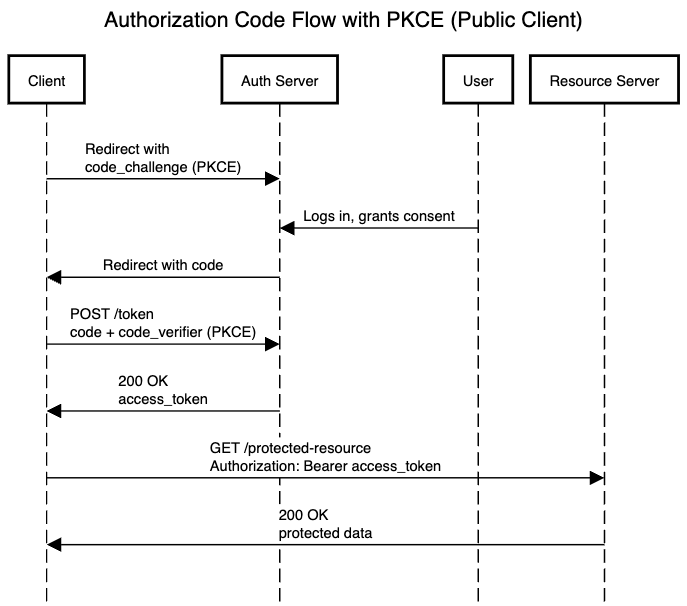
๐Ÿ“ฑ 5. Authorization Code Flow with PKCE (Public Client)

Use Case: Mobile apps or SPAs where secrets cannot be stored securely.

๐Ÿงพ Sequence Diagram

title Authorization Code Flow with PKCE (Public Client)

Client->Auth Server: Redirect with\ncode_challenge (PKCE)
User->Auth Server: Logs in, grants consent
Auth Server->Client: Redirect with code
Client->Auth Server: POST /token\ncode + code_verifier (PKCE)
Auth Server->Client: 200 OK\naccess_token
Client->Resource Server: GET /protected-resource\nAuthorization: Bearer access_token
Resource Server->Client: 200 OK\nprotected data


๐Ÿ”ง Keycloak Setup

  1. Go to Clients → Create a new client

  2. Client ID: my-spa-client

  3. Client Type: Public

  4. Enable Standard Flow Enabled

  5. Set Valid Redirect URIs (e.g. http://localhost:3000/*)

  6. Enable PKCE (enabled by default from Keycloak 18+)

  7. Do not set client secret (public clients should not use one)

curl -X POST \
  https://<keycloak-host>/realms/<realm>/protocol/openid-connect/token \
  -H "Content-Type: application/x-www-form-urlencoded" \
  -d "grant_type=authorization_code" \
  -d "client_id=my-spa-client" \
  -d "code=AUTH_CODE_FROM_CALLBACK" \
  -d "code_verifier=YOUR_CODE_VERIFIER" \
  -d "redirect_uri=http://localhost:3000/callback"

๐Ÿ›ก️ 6. Security Considerations

Risk Applies To Mitigation
Token theft All flows Use HTTPS, secure storage
Secret leakage Confidential Store secrets in vaults, env vars
Replay attacks Public clients Use PKCE with code_verifier
Authorization code leakage All code flows Use state param + PKCE
Refresh token misuse All code flows Issue only to confidential clients

๐Ÿ† 7. Which Flow to Use When?

Flow Client Type User Involved Use Case
Client Credentials Confidential No M2M, background jobs, microservices
Authorization Code Confidential Yes Web apps with secure backend
Auth Code + PKCE Public Yes SPAs, mobile apps

๐Ÿ“„ 8. Summary Table

Flow Requires Secret Safe for Public Refresh Token PKCE Required
Client Credentials Yes No No No
Authorization Code Yes No Yes No
Auth Code + PKCE No Yes Sometimes Yes

๐ŸŒŸ 9. Best Practices

  • Always use PKCE for mobile/web public clients

  • Use short-lived access tokens and rotating refresh tokens

  • Validate state and nonce to prevent CSRF and replay

  • Use scopes to enforce least privilege


๐Ÿš€ 10. Tools to Visualize Sequence Diagrams

All diagrams here are compatible with https://www.websequencediagram.com. Paste any of them to view and customize.


๐Ÿ“ Final Thoughts

Choosing the right OAuth flow depends on:

  • Whether you're authenticating a user or a service

  • Whether the client is trusted to hold secrets

  • Whether the platform supports secure storage

Use this guide as a blueprint to implement secure OAuth 2.0 integrations confidently using Keycloak as your Identity Provider.