August 4, 2025

Comprehensive Job Search Guide for Staff/Lead Engineers

his guide provides a general roadmap, resources, common interview questions, and approximate salary ranges for Staff/Lead Engineer roles, focusing on Java, Microservices, AWS, and GCP. This information can serve as a foundation for your personalized job search and interview preparation.


## 1. Study Roadmap and Key Topics


To excel in Staff/Lead Engineer roles with a focus on Java, Microservices, AWS, and GCP, a deep understanding of the following areas is crucial:


### A. Core Java and Advanced Concepts

*   **JVM Internals:** Memory management (Heap, Stack, Metaspace), Garbage Collection (GC algorithms like G1, CMS, Parallel, Serial), Class Loading.

*   **Concurrency and Multithreading:** `java.util.concurrent` package (Executors, Futures, Callables, Locks, Semaphores, CountDownLatch, CyclicBarrier), Thread Pools, Concurrency issues (deadlock, livelock, starvation), `synchronized` keyword, volatile, Atomic operations.

*   **Data Structures and Algorithms:** Advanced data structures (Tries, Graphs, Heaps), advanced algorithms (dynamic programming, graph algorithms, sorting, searching), time and space complexity analysis.

*   **Object-Oriented Programming (OOP):** SOLID principles, Design Patterns (Creational, Structural, Behavioral - e.g., Singleton, Factory, Observer, Strategy, Decorator, Proxy, Facade, Builder, Adapter, etc.), Abstraction, Encapsulation, Inheritance, Polymorphism.

*   **Java 8+ Features:** Lambdas, Streams API, Functional Interfaces, Optional, Date and Time API (java.time).

*   **Exception Handling:** Best practices, custom exceptions.

*   **Generics:** Type erasure, wildcards.


### B. Microservices Architecture

*   **Principles and Patterns:** Bounded Context, Domain-Driven Design (DDD), API Gateway, Service Discovery, Circuit Breaker, Bulkhead, Saga, CQRS, Event Sourcing.

*   **Communication:** RESTful APIs, gRPC, Message Queues (Kafka, RabbitMQ, SQS), Event-driven architecture.

*   **Spring Boot and Spring Cloud:** Deep dive into Spring Boot features, Spring Cloud components (Eureka, Zuul/Gateway, Hystrix/Resilience4j, Config Server, Sleuth/Zipkin).

*   **Containerization:** Docker (Dockerfile, Docker Compose, Docker Swarm), Containerization best practices.

*   **Orchestration:** Kubernetes (Pods, Deployments, Services, Ingress, StatefulSets, Helm, Operators), K8s networking and storage.

*   **Observability:** Logging (ELK Stack/Grafana Loki), Monitoring (Prometheus, Grafana), Tracing (Jaeger, Zipkin), Health Checks.

*   **Security:** OAuth2, OpenID Connect, JWT, API Security best practices.

*   **Database Strategies:** Polyglot Persistence, Database per Service, Distributed Transactions.


### C. Amazon Web Services (AWS)

*   **Compute:** EC2, Lambda, ECS, EKS (Kubernetes on AWS), Fargate.

*   **Storage:** S3, EBS, EFS, Glacier, RDS (Aurora, PostgreSQL, MySQL), DynamoDB.

*   **Networking:** VPC, Subnets, Route 53, Load Balancers (ALB, NLB), API Gateway, Direct Connect.

*   **Databases:** RDS (various engines), DynamoDB, ElastiCache, Redshift, Aurora.

*   **Messaging & Streaming:** SQS, SNS, Kinesis, MQ.

*   **Identity & Access Management (IAM):** Users, Groups, Roles, Policies, best practices.

*   **Monitoring & Logging:** CloudWatch, CloudTrail, AWS Config.

*   **Deployment & Management:** CloudFormation, CodePipeline, CodeBuild, CodeDeploy, Systems Manager.

*   **Security:** WAF, Shield, KMS, Secrets Manager.

*   **Serverless:** Lambda, API Gateway, DynamoDB, SQS, SNS for serverless architectures.


### D. Google Cloud Platform (GCP)

*   **Compute:** Compute Engine (VMs), Kubernetes Engine (GKE), Cloud Functions, App Engine.

*   **Storage:** Cloud Storage (GCS), Cloud SQL, Cloud Spanner, Firestore, Bigtable.

*   **Networking:** VPC, Load Balancing, Cloud DNS, Cloud CDN, Cloud Interconnect.

*   **Databases:** Cloud SQL, Cloud Spanner, Firestore, Bigtable, Memorystore.

*   **Messaging & Streaming:** Pub/Sub, Dataflow, Dataproc.

*   **Identity & Security:** Cloud IAM, Cloud KMS, Cloud Armor, Security Command Center.

*   **Monitoring & Logging:** Cloud Monitoring, Cloud Logging, Cloud Trace.

*   **Deployment & Management:** Cloud Deployment Manager, Cloud Build, Cloud Source Repositories.

*   **Serverless:** Cloud Functions, Cloud Run, App Engine Standard.


### E. System Design and Architecture

*   **Scalability:** Vertical vs. Horizontal Scaling, Load Balancing, Caching (CDN, application-level, database-level), Database Sharding/Partitioning, Replication.

*   **Reliability:** Redundancy, Fault Tolerance, Disaster Recovery, Backups.

*   **Performance:** Latency, Throughput, Bottleneck identification, Optimization techniques.

*   **Security:** Authentication, Authorization, Encryption, Vulnerability Management.

*   **Consistency Models:** CAP Theorem, ACID vs. BASE.

*   **Distributed Systems Concepts:** Consensus (Paxos, Raft), Distributed Transactions, Leader Election.

*   **Design Trade-offs:** Understanding the compromises involved in different architectural choices.

*   **Common System Design Problems:** Designing a URL shortener, a chat application, a social media feed, a distributed cache, an e-commerce platform, etc.


## 2. General Resources


Here are some general resources to help you study and prepare:


*   **Online Courses:** Coursera, Udemy, edX, Pluralsight offer specialized courses on Java, Spring Boot, Microservices, Docker, Kubernetes, AWS, and GCP.

*   **Official Documentation:** Always refer to the official documentation for Java, Spring, Docker, Kubernetes, AWS, and GCP. They are the most accurate and up-to-date sources.

*   **Books:** "Effective Java" by Joshua Bloch, "Spring in Action" by Craig Walls, "Designing Data-Intensive Applications" by Martin Kleppmann, "System Design Interview – An Insider's Guide" by Alex Xu.

*   **Blogs and Articles:** Follow reputable tech blogs (e.g., Martin Fowler's blog, Baeldung, DZone, InfoQ) for insights into best practices and new technologies.

*   **YouTube Channels:** FreeCodeCamp.org, TechLead, Hussein Nasser, Gaurav Sen, ByteByteGo for system design and technical concepts.

*   **Practice Platforms:** LeetCode, HackerRank, GeeksforGeeks for data structures and algorithms practice. Exponent and Interviewing.io for system design interview practice.

*   **Community Forums:** Stack Overflow, Reddit communities (e.g., r/java, r/microservices, r/aws, r/gcp, r/developersIndia) for discussions and problem-solving.


## 3. Common Types of Interview Questions


Interview processes for Staff/Lead Engineer roles typically involve a combination of behavioral, technical, and system design questions. While specific questions vary by company, the underlying principles and areas of focus remain consistent.


### A. Behavioral Questions

These questions assess your soft skills, leadership potential, problem-solving approach, and how you handle various workplace situations. Prepare to discuss:

*   Tell me about yourself/Walk me through your resume.

*   Why are you interested in this role/company?

*   Describe a challenging project you worked on. What were the challenges, and how did you overcome them?

*   Tell me about a time you failed. What did you learn from it?

*   How do you handle conflict with team members or stakeholders?

*   Describe a situation where you had to lead a team or mentor a junior engineer.

*   How do you prioritize tasks and manage your time effectively?

*   What are your strengths and weaknesses?

*   Where do you see yourself in 3-5 years?


### B. Technical Questions

These questions delve into your knowledge of programming languages, frameworks, and specific technologies. Expect questions related to:


#### Java

*   Deep dive into JVM: Classloaders, Memory Model, Garbage Collection algorithms.

*   Concurrency: Thread synchronization, `java.util.concurrent` package, common concurrency issues (deadlock, race conditions).

*   Design Patterns: Explain and provide examples of common design patterns (e.g., Singleton, Factory, Observer, Strategy, Builder).

*   Spring Boot/Spring Framework: IoC, AOP, Spring Boot starters, auto-configuration, Spring Data JPA, Spring Security.

*   Data Structures & Algorithms: Implement common data structures (linked lists, trees, graphs) and algorithms (sorting, searching, dynamic programming). Analyze time and space complexity.

*   Exception Handling: Checked vs. Unchecked exceptions, best practices.

*   Generics: Type erasure, wildcards.


#### Microservices

*   Microservices vs. Monolith: Pros and cons, when to choose which architecture.

*   Inter-service Communication: REST, gRPC, message queues (Kafka, RabbitMQ, SQS), event-driven architecture.

*   Service Discovery: How does it work? (e.g., Eureka, Consul).

*   API Gateway: Role, benefits, and implementation considerations.

*   Data Management in Microservices: Distributed transactions, Saga pattern, eventual consistency.

*   Containerization & Orchestration: Docker, Kubernetes concepts (Pods, Deployments, Services, Ingress), Helm.

*   Observability: Logging, monitoring, tracing in a distributed system.

*   Security: OAuth2, JWT, API security.


#### AWS/GCP (Cloud Specific)

*   Core Services: Deep understanding of compute (EC2/Compute Engine, Lambda/Cloud Functions, ECS/GKE), storage (S3/Cloud Storage, RDS/Cloud SQL, DynamoDB/Firestore), networking (VPC, Load Balancers, Route 53/Cloud DNS).

*   Serverless Architectures: When to use Lambda/Cloud Functions, API Gateway, DynamoDB/Firestore.

*   Security: IAM roles and policies, security best practices in the cloud.

*   Cost Optimization: Strategies for reducing cloud costs.

*   Disaster Recovery & High Availability: Multi-AZ deployments, backup strategies.

*   CI/CD in Cloud: AWS CodePipeline/CodeBuild/CodeDeploy, GCP Cloud Build.

*   Specific use cases: How would you design a scalable web application on AWS/GCP? How would you migrate an on-premise application to the cloud?


### C. System Design Questions

These are open-ended questions that assess your ability to design scalable, reliable, and maintainable systems. You'll need to consider various aspects like scalability, availability, consistency, fault tolerance, and cost. Common topics include:

*   Design a URL shortener.

*   Design a chat application (e.g., WhatsApp, Messenger).

*   Design a social media feed (e.g., Twitter, Facebook).

*   Design a distributed cache.

*   Design an e-commerce platform.

*   Design a ride-sharing service (e.g., Uber, Lyft).

*   Design a notification system.

*   Design a real-time analytics system.


For system design, focus on:

*   **Requirements Gathering:** Clarify functional and non-functional requirements.

*   **High-Level Design:** Break down the system into major components.

*   **Deep Dive:** Discuss specific components in detail (e.g., database schema, API design, caching strategy, load balancing).

*   **Scalability & Reliability:** How would you handle increased load? What happens if a component fails?

*   **Trade-offs:** Discuss the pros and cons of different design choices.

*   **Bottlenecks:** Identify potential bottlenecks and propose solutions.


## 4. Approximate Salary Ranges for Staff/Lead Engineers in India


Salary expectations for Staff and Lead Engineers in India can vary significantly based on the company (MNC, startup, product-based, service-based), location (Bangalore, Hyderabad, Pune, Delhi-NCR), years of experience, specific skills, and negotiation. However, based on recent market data (as of mid-2025), here are some approximate ranges:


*   **Staff Engineer:**

    *   **Average:** ₹35 LPA - ₹65 LPA

    *   **Top-tier Product Companies (Google, Amazon, Microsoft, Databricks, Rubrik):** ₹60 LPA - ₹1.2 Cr+ LPA (can go significantly higher for Principal/Distinguished Engineers)

    *   **Other Product/High-Growth Startups:** ₹40 LPA - ₹80 LPA


*   **Lead Engineer:**

    *   **Average:** ₹25 LPA - ₹50 LPA

    *   **Top-tier Product Companies:** ₹50 LPA - ₹1 Cr+ LPA

    *   **Other Product/High-Growth Startups:** ₹35 LPA - ₹70 LPA


**Important Considerations:**

*   **Total Compensation:** Salaries often include a base salary, stock options (RSUs), and bonuses. When comparing offers, always consider the total compensation package.

*   **Negotiation:** Salaries are often negotiable. Research market rates thoroughly and be prepared to articulate your value.

*   **Levels.fyi and Glassdoor:** These platforms provide crowd-sourced salary data and can be useful for getting a general idea, but always take them with a grain of salt as data can be skewed or outdated.


This guide should provide a solid starting point for your job search. Remember to tailor your resume and interview preparation to the specific requirements of each company you apply to.


July 31, 2025

๐Ÿ“ฌ Amazon SQS Retry Mechanisms: When to Use DelaySeconds vs Visibility Timeout vs DLQ

Message-driven systems need solid retry mechanisms to gracefully handle transient failures. Amazon SQS (Simple Queue Service) provides a few tools to control retries:

  • DelaySeconds

  • VisibilityTimeout

  • Dead Letter Queues (DLQs)

But when should you use each? Let’s break it down.


๐Ÿ” 1. Visibility Timeout – Automatic Retry Handling

What it is:
When a consumer receives a message from SQS, that message becomes invisible for a duration defined by VisibilityTimeout.

If the consumer fails to delete the message within that time, the message becomes visible again and SQS retries it automatically.

Use Case:

  • For retrying transient failures without custom logic.

  • When using frameworks like Spring Cloud SQS or AWS SDK consumers.

Pros:

  • Simple and automatic

  • No extra code for retrying

Cons:

  • No control over retry timing (it's fixed)

  • Can cause duplicate processing if visibility timeout is too short

Recommended when you just want basic retries with no backoff logic.


⏳ 2. DelaySeconds – Scheduled Retry (Manual Logic)

What it is:
SQS allows setting DelaySeconds on a per-message basis when sending a message. It means: don’t deliver this message until X seconds have passed.

amazonSQS.sendMessage(new SendMessageRequest()
    .withQueueUrl(queueUrl)
    .withMessageBody(messageBody)
    .withDelaySeconds(60)); // Delay for 60 seconds

Use Case:

  • Implement exponential backoff retry logic after a failure

  • Avoid hammering systems with immediate retries

  • Fine-grained control over retry schedule

Pros:

  • Controlled and customizable retry strategy

  • Can implement exponential backoff easily

Cons:

  • Requires extra logic (like tracking retry count)

  • Only works up to 900 seconds (15 minutes)

Recommended when you want advanced retry strategies like exponential backoff.


☠️ 3. Dead Letter Queue (DLQ) – Retry Limit Fallback

What it is:
A DLQ is a secondary queue attached to your primary queue. After a message fails maxReceiveCount times (based on visibility timeout logic), SQS automatically moves it to the DLQ.

Use Case:

  • Capture and isolate messages that consistently fail

  • Avoid infinite retry loops

  • Debug or manually intervene failed cases

Pros:

  • Separates bad messages for inspection

  • Easy monitoring with CloudWatch

Cons:

  • Not a retry mechanism per se — more of a final fallback

Recommended as a safety net, not a retry strategy.


๐Ÿ’ก When to Use What?

Scenario Use VisibilityTimeout Use DelaySeconds Use DLQ
Auto retry after failure ✅ Yes ❌ No ❌ No
Manual retry with delay/backoff ❌ No ✅ Yes ❌ No
Retry with increasing delay (backoff) ❌ No ✅ Yes ❌ No
Capturing failed messages after max tries ✅ (to count retries) ✅ (track retries) ✅ Yes
Real-time processing, quick retry ✅ Yes ❌ No ❌ No
Complex processing with risk of overload ❌ No ✅ Yes ✅ Yes

๐Ÿ› ️ Best Practice Combo

For most robust production systems, use a combination:

  1. Set VisibilityTimeout = 15 min

  2. Implement DelaySeconds with exponential backoff on retries

  3. Configure a DLQ for messages exceeding retry threshold


๐Ÿ“ฆ Sample Java (AWS SDK) Exponential Retry Logic

int retryCount = msg.getRetryCount();
int delay = Math.min(900, (int)Math.pow(2, retryCount) * 30); // Cap at 15min

SendMessageRequest request = new SendMessageRequest()
    .withQueueUrl(queueUrl)
    .withMessageBody(objectMapper.writeValueAsString(msg))
    .withDelaySeconds(delay);

amazonSQS.sendMessage(request);

✅ TL;DR

  • Use VisibilityTimeout for simple, default retry behavior

  • Use DelaySeconds for smart retry logic (like exponential backoff)

  • Always use a DLQ as a fallback to avoid infinite retries


Let me know if you'd like this turned into a Markdown doc or HTML blog template.

July 30, 2025

Understanding Locking in Concurrent Systems (Optimistic, Pessimistic, Distributed)

Imagine you and your friends are editing a shared document. If two people make changes at the same time, someone’s changes might get overwritten. In software systems — especially multi-threaded or distributed applications — this same issue occurs when multiple services or users try to update the same data at once. This is called a concurrency problem.

To solve this, we use locking mechanisms.


๐Ÿ” 1. Optimistic Locking — "Hope for the best, prepare for conflict"

What is it?

Optimistic locking assumes conflicts are rare, so it doesn’t lock anything initially. Instead, it checks whether the data has been modified by someone else just before saving.

How it works?

  • A special field, often called version, is added to your data (e.g., @Version in JPA).

  • When you fetch a record, say version = 3.

  • You modify it and try to save it back.

  • The system checks: is the current version in DB still 3?

    • ✅ Yes: Save and bump version to 4.

    • ❌ No: Someone else updated it. Throw an OptimisticLockException.

@Entity
public class User {
    @Id
    private Long id;

    private String name;

    @Version
    private Long version;
}

Frameworks like Hibernate or JPA handle this automatically behind the scenes using SQL like:

UPDATE user SET name='Jatin', version=4 WHERE id=1 AND version=3;

If no rows are updated, it means someone else already changed it.

When to use?

  • Low contention systems (e.g., user profile updates).

  • REST APIs with stateless calls.

  • Systems where retrying is acceptable.

✅ Pros:

  • No locks, better performance.

  • Scales well.

❌ Cons:

  • Write conflicts lead to retries.

  • Not ideal for high-write, high-conflict cases.


๐Ÿ”’ 2. Pessimistic Locking — "Lock first, then act"

What is it?

Pessimistic locking assumes conflicts are likely. So, it locks the data before anyone can modify it.

How it works?

When one process reads data with a lock (SELECT ... FOR UPDATE), others are blocked from reading/updating it until the lock is released (usually after a commit or rollback).

@Lock(LockModeType.PESSIMISTIC_WRITE)
Optional<User> findById(Long id);

Internally, this generates SQL like:

SELECT * FROM user WHERE id = 1 FOR UPDATE;

This locks the row, so no other transaction can modify it until yours is done.

When to use?

  • High contention systems.

  • Critical operations like bank transfers, inventory deduction.

  • When conflicts must be avoided at all costs.

✅ Pros:

  • Safe and conflict-free.

  • No need to retry updates.

❌ Cons:

  • Performance hit due to locking.

  • Can cause deadlocks or long wait times.

  • Doesn't scale well in high concurrency.


๐ŸŒ 3. Distributed Locking — "One lock to rule them all"

What is it?

Distributed locking is used in distributed systems (multiple services or pods/machines) where shared DB row-level locks or JVM locks don’t work.

How it works?

  • A centralized locking service (like Redis, Zookeeper, or etcd) is used.

  • The system tries to acquire a lock on a key (SET lock_key "uuid" NX PX 30000 in Redis).

  • If successful, it proceeds. Otherwise, waits or fails.

  • Releases the lock explicitly or after timeout.

Libraries/tools:

  • Redisson for Redis

  • Hazelcast

  • Apache Curator (for Zookeeper)

RLock lock = redissonClient.getLock("lock:resource:123");
try {
    if (lock.tryLock(10, 30, TimeUnit.SECONDS)) {
        // Do critical work
    }
} finally {
    lock.unlock();
}

When to use?

  • Multi-instance services (e.g., microservices, Kubernetes pods).

  • Cron jobs or batch processing to ensure only one instance does the work.

  • Event-driven or message-processing systems.

✅ Pros:

  • Works across machines, containers, services.

  • Flexible with fine-grained control.

❌ Cons:

  • More complex.

  • Needs external infra (Redis, etc.).

  • Must handle failures, timeouts, and race conditions properly.


๐Ÿง  How to Learn More

Topic Resources
JPA Optimistic Locking Baeldung Optimistic Locking
SQL Pessimistic Locking PostgreSQL FOR UPDATE
Distributed Locking Redisson Docs
Concepts & Patterns Designing Data-Intensive Applications by Martin Kleppmann

๐Ÿค” Summary: Which One to Use?

Locking Type Use Case Scalability Conflict Handling
Optimistic Most REST APIs, low-write conflicts ✅ High Retry
Pessimistic High-conflict updates (banking, booking) ❌ Low Block & wait
Distributed Multi-instance processing (jobs, microservices) ✅ High Explicit locking logic

Let me know if you want this as a Markdown file or blog-ready HTML version.

July 1, 2025

๐Ÿ” OAuth 2.0 Overview: Introduction to Standards Protocol Flows and Integration with Keycloak

OAuth 2.0 is the gold standard for delegated authorization. It provides multiple flows to suit different application types and trust levels. This guide dives deep into:

  • Recap the AuthN and AuthZ

  • OAuth 2.0 Flows: Client Credentials, Authorization Code, and Authorization Code with PKCE

  • Client types: Confidential and Public

  • Sequence diagrams for each flow (compatible with https://www.websequencediagram.com)

  • Keycloak configuration examples for each flow

  • curl commands to request tokens from Keycloak

  • Security concerns, best practices, and when to use what

๐Ÿ” What is Authentication and Authorization?

ConceptMeaningExample
AuthenticationVerifying who you are.Logging in with username/password, or Google login to prove your identity.
AuthorizationVerifying what you can do or access after authentication.Can this user access /admin page or update a record after logging in?

๐Ÿงญ Purpose and Use

AspectAuthenticationAuthorization
GoalProve identityControl access to resources
Happens when?First stepAfter authentication
Protocol ExamplesOpenID Connect (on top of OAuth 2)OAuth 2.0 (Authorization Framework)
Who uses the data?Login system (e.g., Keycloak)Backend/API/gateway with access policies
Typical DataUsername, password, biometricsRoles, permissions, scopes

๐Ÿ› ️ Which Protocol Does What?

Flow or ProtocolUsed ForHandles Authentication?Handles Authorization?
OAuth 2.0Delegated access❌ No✅ Yes
OpenID Connect (OIDC)Identity layer on OAuth✅ Yes (who the user is)✅ Sometimes (via scopes/claims)
SAMLEnterprise SSO✅ Yes✅ Yes
Basic Auth / Form LoginSimple login systems✅ Yes❌ No

๐Ÿ”‘ In OAuth 2.0 Context

  • Authentication: Usually handled by OIDC or a login form in the Identity Provider (IdP) like Keycloak.

  • Authorization: Managed through OAuth 2.0 scopes, roles, or resource server policies.

๐Ÿ“˜ 1. What is an OAuth Client?

An OAuth client is an application requesting access to protected resources on a user's behalf or on its own behalf.


๐Ÿ› ️ 2. Client Types: Confidential vs Public

Type Can Store Secrets? Typical Examples
Confidential Yes Server-side apps, CLIs
Public No Mobile apps, SPAs

✅ 3. Client Credentials Flow (Confidential Client)

Use Case: Service-to-service or machine-to-machine communication (no end-user).

๐Ÿงพ Sequence Diagram

title Client Credentials Flow (Confidential Client)

Client->Auth Server: POST /token\nclient_id + client_secret\ngrant_type=client_credentials
Auth Server->Client: 200 OK\naccess_token
Client->Resource Server: GET /protected-resource\nAuthorization: Bearer access_token
Resource Server->Client: 200 OK\nprotected data


๐Ÿ”ง Keycloak Setup

  1. Go to Clients → Create a new client

  2. Client ID: my-service-client

  3. Client Type: Confidential

  4. Enable Service Accounts Enabled

  5. Set credentials and copy client_id & client_secret

  6. Assign appropriate client roles under Service Account Roles

  7. Token Endpoint: https://<keycloak-host>/realms/<realm>/protocol/openid-connect/token

curl -X POST \
  https://<keycloak-host>/realms/<realm>/protocol/openid-connect/token \
  -H "Content-Type: application/x-www-form-urlencoded" \
  -d "grant_type=client_credentials" \
  -d "client_id=my-service-client" \
  -d "client_secret=YOUR_CLIENT_SECRET"

๐Ÿ™‹‍♂️ 4. Authorization Code Flow (Confidential Client)

Use Case: Web applications with backend able to keep secrets. Requires user login.

๐Ÿงพ Sequence Diagram

title Authorization Code Flow (Confidential Client)

Client->User: Redirect to Auth Server login
User->Auth Server: Logs in, grants consent Auth Server->Client: Redirect with code Client->Auth Server: POST /token\ncode + client_id + client_secret Auth Server->Client: 200 OK\naccess_token + refresh_token Client->Resource Server: GET /protected-resource\nAuthorization: Bearer access_token Resource Server->Client: 200 OK\nprotected data


๐Ÿ”ง Keycloak Setup

  1. Go to Clients → Create a new client

  2. Client ID: my-web-client

  3. Client Type: Confidential

  4. Root URL: https://your-app.com

  5. Valid Redirect URIs: https://your-app.com/callback

  6. Enable Standard Flow Enabled

  7. Note the token endpoint: https://<keycloak-host>/realms/<realm>/protocol/openid-connect/token

curl -X POST \
  https://<keycloak-host>/realms/<realm>/protocol/openid-connect/token \
  -H "Content-Type: application/x-www-form-urlencoded" \
  -d "grant_type=authorization_code" \
  -d "client_id=my-web-client" \
  -d "client_secret=YOUR_CLIENT_SECRET" \
  -d "code=AUTH_CODE_FROM_CALLBACK" \
  -d "redirect_uri=https://your-app.com/callback"

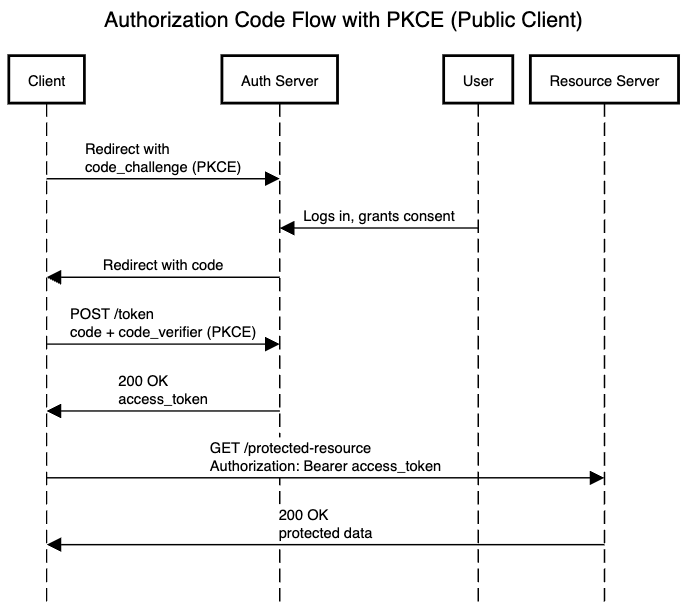
๐Ÿ“ฑ 5. Authorization Code Flow with PKCE (Public Client)

Use Case: Mobile apps or SPAs where secrets cannot be stored securely.

๐Ÿงพ Sequence Diagram

title Authorization Code Flow with PKCE (Public Client)

Client->Auth Server: Redirect with\ncode_challenge (PKCE)
User->Auth Server: Logs in, grants consent
Auth Server->Client: Redirect with code
Client->Auth Server: POST /token\ncode + code_verifier (PKCE)
Auth Server->Client: 200 OK\naccess_token
Client->Resource Server: GET /protected-resource\nAuthorization: Bearer access_token
Resource Server->Client: 200 OK\nprotected data


๐Ÿ”ง Keycloak Setup

  1. Go to Clients → Create a new client

  2. Client ID: my-spa-client

  3. Client Type: Public

  4. Enable Standard Flow Enabled

  5. Set Valid Redirect URIs (e.g. http://localhost:3000/*)

  6. Enable PKCE (enabled by default from Keycloak 18+)

  7. Do not set client secret (public clients should not use one)

curl -X POST \
  https://<keycloak-host>/realms/<realm>/protocol/openid-connect/token \
  -H "Content-Type: application/x-www-form-urlencoded" \
  -d "grant_type=authorization_code" \
  -d "client_id=my-spa-client" \
  -d "code=AUTH_CODE_FROM_CALLBACK" \
  -d "code_verifier=YOUR_CODE_VERIFIER" \
  -d "redirect_uri=http://localhost:3000/callback"

๐Ÿ›ก️ 6. Security Considerations

Risk Applies To Mitigation
Token theft All flows Use HTTPS, secure storage
Secret leakage Confidential Store secrets in vaults, env vars
Replay attacks Public clients Use PKCE with code_verifier
Authorization code leakage All code flows Use state param + PKCE
Refresh token misuse All code flows Issue only to confidential clients

๐Ÿ† 7. Which Flow to Use When?

Flow Client Type User Involved Use Case
Client Credentials Confidential No M2M, background jobs, microservices
Authorization Code Confidential Yes Web apps with secure backend
Auth Code + PKCE Public Yes SPAs, mobile apps

๐Ÿ“„ 8. Summary Table

Flow Requires Secret Safe for Public Refresh Token PKCE Required
Client Credentials Yes No No No
Authorization Code Yes No Yes No
Auth Code + PKCE No Yes Sometimes Yes

๐ŸŒŸ 9. Best Practices

  • Always use PKCE for mobile/web public clients

  • Use short-lived access tokens and rotating refresh tokens

  • Validate state and nonce to prevent CSRF and replay

  • Use scopes to enforce least privilege


๐Ÿš€ 10. Tools to Visualize Sequence Diagrams

All diagrams here are compatible with https://www.websequencediagram.com. Paste any of them to view and customize.


๐Ÿ“ Final Thoughts

Choosing the right OAuth flow depends on:

  • Whether you're authenticating a user or a service

  • Whether the client is trusted to hold secrets

  • Whether the platform supports secure storage

Use this guide as a blueprint to implement secure OAuth 2.0 integrations confidently using Keycloak as your Identity Provider.

June 30, 2025

๐Ÿ”️ Finding a Peak Element in an Array — Efficient Solutions in Java (with Java 21 Best Practices)

๐Ÿ“Œ Problem Statement

You are given an integer array nums. Your task is to find a peak element and return its index.

A peak element is one that is:

  • strictly greater than its neighbors.

  • i.e., nums[i - 1] < nums[i] > nums[i + 1].

Special Notes:

  • You only need to return any one peak — not all.

  • The array may have multiple peaks.

  • Assume nums[-1] and nums[n] are -∞ (imaginary values outside the array).


๐Ÿง  Intuition — What Is the Question Really Asking?

Imagine you're walking along a mountain trail, and someone asks:

“Can you find a point where you're standing on a hilltop, higher than both the person behind you and ahead of you?”

You don’t need the highest mountain, just any place where you're on top compared to your neighbors.

Why is this interesting?

Because instead of checking every point on the trail, you can cleverly skip sections using the idea that:

  • If you're going uphill, a peak must lie ahead.

  • If you're going downhill, a peak must lie behind or at your current position.

This observation is perfect for binary search — we can reduce our search space by half each time.


๐Ÿงช Example

Given:

int[] nums = {1, 2, 3, 1};
  • At index 2, nums[2] = 3, and 3 > 2 and 3 > 1 → so index 2 is a peak.


๐Ÿšถ‍♂️ Approach 1: Brute Force (Linear Scan)

Go element by element and check if it's greater than its neighbors.

public static int findPeakLinear(int[] nums) {
    for (int i = 0; i < nums.length; i++) {
        boolean leftOk = (i == 0 || nums[i] > nums[i - 1]);
        boolean rightOk = (i == nums.length - 1 || nums[i] > nums[i + 1]);
        if (leftOk && rightOk) return i;
    }
    return -1; // fallback
}

✅ Pros:

  • Very easy to implement

❌ Cons:

  • Time complexity: O(n)

  • Not efficient for large arrays


⚡ Approach 2: Binary Search (Optimal and Recommended)

Use the fact that a peak exists if the slope changes from rising to falling. If nums[mid] < nums[mid + 1], move right. Else, move left.

Java 21 Version

public class PeakFinder {

    public static int findPeakElement(int[] nums) {
        if (nums == null || nums.length == 0)
            throw new IllegalArgumentException("Array must not be null or empty");

        int left = 0, right = nums.length - 1;

        while (left < right) {
            int mid = Math.addExact(left, (right - left) / 2);

            if (nums[mid] < nums[mid + 1]) {
                left = mid + 1; // peak is to the right
            } else {
                right = mid; // peak is to the left or at mid
            }
        }

        return left;
    }
}

⏱️ Time: O(log n)

๐Ÿ“ฆ Space: O(1)

✅ Pros:

  • Very efficient

  • Guarantees a peak due to the problem’s conditions


๐Ÿงฉ Approach 3: Recursive Divide and Conquer

Same logic as binary search, but using recursion:

public class PeakFinder {

    public static int findPeakRecursive(int[] nums) {
        return search(nums, 0, nums.length - 1);
    }

    private static int search(int[] nums, int left, int right) {
        if (left == right) return left;

        int mid = left + (right - left) / 2;

        if (nums[mid] < nums[mid + 1]) {
            return search(nums, mid + 1, right);
        } else {
            return search(nums, left, mid);
        }
    }
}

๐Ÿ“ˆ Real-World Analogy (Peak Hiker)

Think of yourself as a hiker on a trail:

  • When the path is going up, you know a peak is ahead.

  • When the path goes down, the peak was behind or at your feet.

  • If you're already on a peak, stop walking.

Binary search lets you skip large parts of the trail because you're always choosing the direction that guarantees a peak exists.


๐Ÿง  Why Binary Search Works Here

Even though the array is not sorted, you can still apply binary search because:

  • There is always at least one peak.

  • At each step, you can eliminate half the array based on the comparison of nums[mid] and nums[mid+1].


✅ Summary Table

Approach Time Complexity Space Complexity Best Use Case
Linear Scan O(n) O(1) Small inputs or quick demo
Binary Search O(log n) O(1) Optimal, all scenarios ✅
Recursive O(log n) O(log n) When recursion is preferred

๐Ÿ’ก Interview Tip

Even if the array isn't sorted, binary search can still be applied in problems where the structure allows elimination of search space — and this is a perfect example.


๐Ÿ› ️ Extras for Practice

  • Modify to find all peak elements

  • Apply a similar approach for a 2D matrix peak problem

  • Implement in a functional style using Java Streams (advanced)


Would you like this content:

  • Exported as HTML for Blogger?

  • Converted to Markdown for Dev.to or GitHub Pages?

  • Embedded with code playground for interactive testing?

Let me know — I can format it to suit your blog setup!

June 27, 2025

๐ŸŒŸ The Servant Leader Problem – A Modern Corporate Dilemma

“The best leaders are those who serve.”
— Robert Greenleaf, Founder of Servant Leadership Philosophy

In today’s corporate world, leadership is no longer about power—it’s about purpose. The Servant Leader model has gained massive popularity for its people-first approach. But despite its noble intent, servant leadership can backfire if misunderstood or poorly applied.

This blog explores the Servant Leader Problem:
Why does a leadership style built on empathy sometimes fail?
And how can we fix it?


๐Ÿ” What Is Servant Leadership?

Servant Leadership is a leadership philosophy where the leader's main goal is to serve others—employees, customers, and the organization—before themselves.

๐Ÿ”‘ Core Principles:

  • Listening actively

  • Putting others’ needs first

  • Empowering team members

  • Promoting growth and well-being

  • Leading by example, not authority

Think of a team manager who ensures the intern is confident before a big client call, or a CTO who skips credit to highlight her team’s work.


๐Ÿ† Why It Works (When It Works)

Organizations like Southwest Airlines, Starbucks, and Infosys have leveraged servant leadership to:

✅ Build trust and loyalty
✅ Reduce attrition
✅ Drive innovation
✅ Boost morale and collaboration

In Agile environments (Scrum, SAFe), the Scrum Master is designed as a servant leader — someone who clears blockers and enables the team to deliver value.


⚠️ The Servant Leader Problem: When Service Becomes a Setback

๐Ÿ“‰ Problem 1: Loss of Authority

When leaders focus solely on serving, they may fail to set boundaries. Team members may:

  • Take liberties

  • Undervalue the leader’s authority

  • Avoid accountability

๐Ÿ—ฃ “My manager is too soft — nothing happens even if I miss deadlines.”


๐Ÿ˜ฐ Problem 2: Burnout & Emotional Exhaustion

Servant leaders often carry everyone’s burdens:

  • Handling team issues

  • Soothing clients

  • Taking work home

Over time, they become drained, affecting their health and leadership clarity.

๐Ÿ’ฌ “I help everyone, but I’m running on empty.”


๐ŸŒ Problem 3: Decision Paralysis

Trying to involve everyone in every decision can delay action. In high-stakes or fast-paced environments, this leads to:

  • Missed opportunities

  • Poor crisis response

๐Ÿง  “Let’s wait until we hear from the whole team” becomes the default — even when time-sensitive.


๐Ÿง  Root Cause: Misinterpretation of “Service”

Many assume servant leadership means pleasing everyone. In truth, it means serving the mission through the people, not at the cost of results.

Servant leadership ≠ People-pleasing
Servant leadership = People-empowering


✅ Striking the Balance: The Empowered Servant Leader

Great leaders serve without surrendering control. They know:

  • When to step in

  • When to say “No”

  • How to guide without dominating

Trait Unbalanced Servant Empowered Servant Leader
Decision Making Seeks endless consensus Invites input, decides firmly
Accountability Absorbs all blame Shares responsibility
Workload Does everything for others Coaches others to own outcomes
Presence Avoids confrontation Handles tough talks respectfully

๐Ÿ’ผ Real Corporate Example: Ravi, the Tech Lead

Ravi, a tech lead at a SaaS company, followed servant leadership to the letter:

  • Protected juniors from client pressure

  • Volunteered for everyone’s unfinished work

  • Delayed decisions to include every opinion

Result?

  • Team became over-reliant

  • Deliverables slipped

  • Ravi burned out

  • Leadership was reassigned

๐Ÿšจ Intent was good. Execution wasn’t.


๐Ÿ› ️ How to Fix the Servant Leader Problem

1. Lead with Boundaries

“I care about your growth, but we must meet deadlines.”

2. Serve the Mission First

Empower people in a way that aligns with company goals.

3. Balance Empathy with Expectations

Support without compromising accountability.

4. Model Self-Care

Show that leaders also need rest, clarity, and limits.


๐Ÿ’ฌ Final Thought

“You don’t lead by pointing and telling people where to go. You lead by going to that place and making a case.”
— Ken Kesey

Great servant leaders:

  • Empower, not enable

  • Listen, but lead

  • Serve, but also steer

In the corporate world, the servant leader is not the weakest in the room. They’re the strongest — because they lift everyone without falling themselves.


๐Ÿ“Œ Summary (TL;DR):

✅ Servant Leadership Strengths ⚠️ Servant Leader Problems
Builds trust & loyalty Can lose authority
Boosts team performance Risks burnout
Enhances collaboration Slows decisions
Empowers people May lack boundaries

๐Ÿ”‘ Fix: Serve with structure. Lead with empathy — but don’t forget to lead.


June 25, 2025

๐Ÿ”ข Mastering Relative Sorting in Java (With Java 8 Best Practices)

Sorting an array based on another array's order is a popular coding problem seen in interviews and real-world systems where custom sorting logic is required.


๐Ÿงฉ Problem Statement

You're given two arrays:

  • arr1: The array you need to sort.

  • arr2: Specifies the relative ordering of some elements.

๐Ÿ“Œ Sort Rules:

  1. Elements from arr1 that are in arr2 appear first, in the same order as in arr2.

  2. Remaining elements (not in arr2) are sorted in ascending order.


✅ Example

Input:
arr1 = [2,3,1,3,2,4,6,7,9,2,19]
arr2 = [2,1,4,3,9,6]

Output:
[2,2,2,1,4,3,3,9,6,7,19]

๐Ÿงช Approach 1: Counting Sort (Optimal if Range is Known)

✅ Code:

public int[] relativeSortArray(int[] arr1, int[] arr2) {
    int[] count = new int[1001]; // assume elements are in 0–1000 range
    for (int num : arr1) count[num]++;

    int[] result = new int[arr1.length];
    int i = 0;

    for (int num : arr2)
        while (count[num]-- > 0)
            result[i++] = num;

    for (int num = 0; num < count.length; num++)
        while (count[num]-- > 0)
            result[i++] = num;

    return result;
}

✅ When to Use:

  • You know the range of input (e.g., 0 to 1000).

  • Performance is critical (time complexity: O(n + m + k)).

  • Memory usage is acceptable for fixed range.

๐Ÿง  Tips:

  • Preallocate frequency arrays if range is predictable.

  • Avoid using this for values outside a known range (e.g., negative numbers, large integers).


๐ŸŒŸ Approach 2: Java 8 Functional Solution (Elegant & Flexible)

✅ Code:

import java.util.*;
import java.util.stream.Collectors;

public class Solution {
    public int[] relativeSortArray(int[] arr1, int[] arr2) {
        Map<Integer, Integer> indexMap = new HashMap<>();
        for (int i = 0; i < arr2.length; i++) indexMap.put(arr2[i], i);

        List<Integer> list = Arrays.stream(arr1).boxed().collect(Collectors.toList());

        list.sort((a, b) -> {
            if (indexMap.containsKey(a) && indexMap.containsKey(b))
                return Integer.compare(indexMap.get(a), indexMap.get(b));
            else if (indexMap.containsKey(a))
                return -1;
            else if (indexMap.containsKey(b))
                return 1;
            else
                return Integer.compare(a, b);
        });

        return list.stream().mapToInt(Integer::intValue).toArray();
    }
}

✅ When to Use:

  • You want a cleaner, more readable solution.

  • The input range is unknown or unbounded.

  • You’re working in a modern Java codebase that uses Streams and Lambdas.


๐Ÿง  Best Practices & Tips

Practice Tip
๐Ÿ”ข Choose Right Approach Use counting sort for known integer ranges. Use Java 8 functional approach for readability and flexibility.
♻️ Avoid Magic Numbers Use Integer.MAX_VALUE or define range constants instead of hardcoding 1001.
๐Ÿ” Handle Edge Cases Always account for: duplicates, missing values in arr2, or values in arr2 not present in arr1.
⚙️ Immutable Data Prefer working with immutable streams when functional clarity matters.
๐Ÿ”„ Convert Safely Use boxed() and mapToInt() to safely convert between primitives and wrappers.
๐Ÿš€ Optimize for Large Input Counting sort is more performant than stream sorting when input size is large and value range is small.
๐Ÿงช Unit Testing Cover edge cases like arr2 being empty, all values in arr1 being outside arr2, etc.

๐Ÿ“š Summary

Feature Counting Sort Java 8 Functional
Input Range Required ✅ Yes (e.g., 0–1000) ❌ No
Duplicates ✅ Handled ✅ Handled
Readability ❌ Medium ✅ High
Performance ✅ Faster for small range ❌ Slightly Slower
Suitable for Interviews ✅ Yes ✅ Yes (bonus if explained well)

๐Ÿง‘‍๐Ÿ’ป Final Thoughts

Both approaches are valid and useful depending on your context:

  • For interview coding rounds, start with the counting sort for performance, then mention the Java 8 version as a cleaner alternative.

  • For production code, prefer the Java 8 solution unless performance is critical and the input range is tightly controlled.

June 16, 2025

AWS Lambda vs AWS Step Functions: Choosing the Right Serverless Tool

 In the world of serverless computing, two of the most powerful and widely used services offered by AWS are Lambda and Step Functions. While both serve critical roles in modern application development, understanding their strengths, limitations, and when to use each is key to building efficient and scalable systems.


What is AWS Lambda?

AWS Lambda is a compute service that lets you run code without provisioning or managing servers. It executes your code only when needed and scales automatically.

Key Features:

  • Supports multiple programming languages (Node.js, Python, Java, etc.)

  • Triggered by events from AWS services like S3, API Gateway, DynamoDB

  • Ideal for short-lived, stateless functions

  • Pay-per-use billing model (based on number of requests and execution time)

Common Use Cases:

  • Resizing images uploaded to S3

  • Backend APIs

  • Real-time file processing

  • Lightweight ETL jobs


What are AWS Step Functions?

AWS Step Functions is an orchestration service that enables you to coordinate multiple AWS services into serverless workflows. It uses a state machine model to define and manage each step.

Key Features:

  • Define workflows in JSON or YAML

  • Visual workflow builder (Workflow Studio)

  • Built-in error handling, retries, and parallelism

  • Integrates with over 200 AWS services directly

  • Two types: Standard (long-running workflows) and Express (high-throughput, short-lived workflows)

Common Use Cases:

  • Orchestrating microservices

  • Data pipelines

  • Approval workflows

  • Long-running business processes


Lambda vs Step Functions: A Comparison

Feature AWS Lambda AWS Step Functions
Purpose Execute code Orchestrate workflows
Execution Time Limit Up to 15 minutes Up to 1 year (Standard), 5 mins (Express)
State Management Manual Built-in
Error Handling In-code try/catch Declarative Retry/Catch per state
Parallel Execution Manual logic required Built-in Parallel state
Visual Debugging Logs only (CloudWatch) Full execution trace and workflow map
Best For Single, short tasks Coordinating multi-step workflows

When to Use Lambda

Use AWS Lambda when you:

  • Need to perform a single task in response to an event

  • Require fast and lightweight processing

  • Don't need to manage state between executions

  • Want simple, cost-effective compute


When to Use Step Functions

Use AWS Step Functions when you:

  • Need to coordinate multiple AWS services or Lambda functions

  • Require visual monitoring and debugging

  • Want built-in error handling and retry logic

  • Are building long-running or complex workflows


Real-World Example

Scenario: A photo processing pipeline

With Lambda only: You’d need to manage invocation of each processing step (e.g., resizing, watermarking, storing) manually, handle retries and errors in code.

With Step Functions: Each step is defined as a state. You gain clear visibility, parallel processing (e.g., for different sizes), and built-in retries.


Conclusion

Both AWS Lambda and Step Functions are integral to serverless development, but they shine in different areas. For independent, simple functions, Lambda is the go-to choice. For multi-step, error-prone, or complex processes, Step Functions provide powerful orchestration capabilities.

Understanding when to use each will help you design better, more scalable, and maintainable serverless architectures.

AWS Lambda vs AWS Step Functions: Choosing the Right Serverless Tool

In the world of serverless computing, two of the most powerful and widely used services offered by AWS are Lambda and Step Functions. While both serve critical roles in modern application development, understanding their strengths, limitations, and when to use each is key to building efficient and scalable systems.


What is AWS Lambda?

AWS Lambda is a compute service that lets you run code without provisioning or managing servers. It executes your code only when needed and scales automatically.

Key Features:

  • Supports multiple programming languages (Node.js, Python, Java, etc.)

  • Triggered by events from AWS services like S3, API Gateway, DynamoDB

  • Ideal for short-lived, stateless functions

  • Pay-per-use billing model (based on number of requests and execution time)

Common Use Cases:

  • Resizing images uploaded to S3

  • Backend APIs

  • Real-time file processing

  • Lightweight ETL jobs


What are AWS Step Functions?

AWS Step Functions is an orchestration service that enables you to coordinate multiple AWS services into serverless workflows. It uses a state machine model to define and manage each step.

Key Features:

  • Define workflows in JSON or YAML

  • Visual workflow builder (Workflow Studio)

  • Built-in error handling, retries, and parallelism

  • Integrates with over 200 AWS services directly

  • Two types: Standard (long-running workflows) and Express (high-throughput, short-lived workflows)

Common Use Cases:

  • Orchestrating microservices

  • Data pipelines

  • Approval workflows

  • Long-running business processes


Lambda vs Step Functions: A Comparison

Feature AWS Lambda AWS Step Functions
Purpose Execute code Orchestrate workflows
Execution Time Limit Up to 15 minutes Up to 1 year (Standard), 5 mins (Express)
State Management Manual Built-in
Error Handling In-code try/catch Declarative Retry/Catch per state
Parallel Execution Manual logic required Built-in Parallel state
Visual Debugging Logs only (CloudWatch) Full execution trace and workflow map
Best For Single, short tasks Coordinating multi-step workflows

When to Use Lambda

Use AWS Lambda when you:

  • Need to perform a single task in response to an event

  • Require fast and lightweight processing

  • Don't need to manage state between executions

  • Want simple, cost-effective compute


When to Use Step Functions

Use AWS Step Functions when you:

  • Need to coordinate multiple AWS services or Lambda functions

  • Require visual monitoring and debugging

  • Want built-in error handling and retry logic

  • Are building long-running or complex workflows


Real-World Example

Scenario: A photo processing pipeline

With Lambda only: You’d need to manage invocation of each processing step (e.g., resizing, watermarking, storing) manually, handle retries and errors in code.

With Step Functions: Each step is defined as a state. You gain clear visibility, parallel processing (e.g., for different sizes), and built-in retries.


Conclusion

Both AWS Lambda and Step Functions are integral to serverless development, but they shine in different areas. For independent, simple functions, Lambda is the go-to choice. For multi-step, error-prone, or complex processes, Step Functions provide powerful orchestration capabilities.

Understanding when to use each will help you design better, more scalable, and maintainable serverless architectures.

June 13, 2025

๐Ÿงต Mastering Singleton Pattern in Java: volatile, synchronized, Spring Bean Scopes & Java 25 Best Practices

๐Ÿง  What is Singleton?

A Singleton ensures only one instance of a class is created and provides a global access point to it.

This is useful for:

  • Configuration classes

  • Logger objects

  • Database connection managers

  • Caching systems


๐Ÿ›‘ Problem: Thread-Unsafe Lazy Singleton

public class Singleton {
    private static Singleton instance;

    private Singleton() {}

    public static Singleton getInstance() {
        if (instance == null) {
            instance = new Singleton(); // ❌ Thread unsafe
        }
        return instance;
    }
}

This code may create multiple instances in a multithreaded environment.


✅ Proper Thread-Safe Singleton with volatile + synchronized

public class Singleton {

    private static volatile Singleton instance;

    private Singleton() {}

    public static Singleton getInstance() {
        if (instance == null) {
            synchronized (Singleton.class) {
                if (instance == null) {
                    instance = new Singleton();
                }
            }
        }
        return instance;
    }
}

⚙️ Modern Singleton Alternatives

๐Ÿ”น Static Holder Pattern

public class Singleton {
    private Singleton() {}
    private static class Holder {
        private static final Singleton INSTANCE = new Singleton();
    }
    public static Singleton getInstance() {
        return Holder.INSTANCE;
    }
}

๐Ÿ”น Enum-based Singleton

public enum Singleton {
    INSTANCE;
}

๐ŸŒฟ Singleton in Spring Framework

Spring beans are Singleton by default, meaning:

Only one instance of the bean is created per Spring container.

✅ Declaring a Singleton Bean (default)

@Component
public class AppConfig {
    // default scope is Singleton
}

or explicitly:

@Component
@Scope("singleton")
public class AppConfig {
}

๐Ÿ”„ Changing Bean Scope in Spring

You can control a bean’s scope using the @Scope annotation.

Available Scopes in Spring (Core)

Scope Description
singleton One shared instance per Spring context (default)
prototype A new instance is created every time it's requested
request One instance per HTTP request (Web only)
session One instance per HTTP session (Web only)
application One instance per ServletContext (Web only)
websocket One instance per WebSocket session

๐Ÿ”ง How to Change Bean Scope

@Component
@Scope("prototype")
public class ReportGenerator {
    // A new instance is returned every time it's injected
}

Or using XML (for older Spring):

<bean id="myBean" class="com.example.MyBean" scope="prototype"/>

๐Ÿงช How to Control and Verify Scope

Example Test Class:

@SpringBootTest
public class ScopeTest {

    @Autowired
    private ApplicationContext context;

    @Test
    void testScope() {
        MyBean b1 = context.getBean(MyBean.class);
        MyBean b2 = context.getBean(MyBean.class);

        System.out.println(b1 == b2 ? "Singleton" : "Prototype");
    }
}

๐Ÿ’Ž Java 25 Best Practices for Singleton

✅ Use volatile in lazy initialization
✅ Use @Scope("singleton") in Spring for explicit intent
✅ Use enum to prevent reflection/cloning
✅ Avoid heavy logic in constructor
✅ Override readResolve() if serializing
✅ Use @ThreadSafe for clarity
✅ Use JMH to benchmark Singleton performance
✅ Prefer DI-managed beans (Spring, Micronaut, etc.)
✅ Protect against classloader issues in plugins


๐Ÿ”š Conclusion

  • Use volatile and synchronized together in double-checked locking.

  • Use static inner class or enum for better control.

  • In Spring, prefer letting the container manage Singleton scope.

  • Change scope using @Scope, depending on your app needs.


✨ Summary Table

Singleton Pattern Thread-safe Lazy Init Recommended
static instance
synchronized method ⚠️
volatile + sync
Static holder ✅✅
Enum ✅✅ ✅✅✅
Spring Singleton Bean ✅✅✅

Would you like this exported as a Markdown file, HTML, or copy-ready for Medium/Dev.to?

June 12, 2025

Understanding authSession.setAction(AUTHENTICATE) and Related Settings in Keycloak Login Flows

When customizing login flows in Keycloak—especially during first login with an identity provider (IdP)—you often interact with the AuthenticationSessionModel and AuthenticatedClientSessionModel. If you’ve looked at lines like the following and wondered what they do or why they’re necessary, this blog is for you:

authSession.setProtocol(OIDCLoginProtocol.LOGIN_PROTOCOL);
authSession.setClientNote(OIDCLoginProtocol.ISSUER, Urls.realmIssuer(session.getContext().getUri().getBaseUri(), realm.getName()));
authSession.setClientNote(OIDCLoginProtocol.SCOPE_PARAM, "openid");
authSession.setAction(AuthenticatedClientSessionModel.Action.AUTHENTICATE.name());

๐ŸŽฏ Problem Statement

In a custom login flow, particularly when modifying the first broker login flow, missing or incorrect session attributes can result in:

  • invalid_request or invalid_signature errors

  • missing id_tokens

  • broken post-login steps like account linking or consent pages

  • failure to issue access or refresh tokens

To ensure smooth interoperability between Keycloak and the OIDC protocol, it's essential to explicitly configure the authSession.


๐Ÿงช What Each Line Does and Why It Matters

1️⃣ authSession.setProtocol(OIDCLoginProtocol.LOGIN_PROTOCOL);

  • Purpose: Tells Keycloak that the current session is using the openid-connect protocol.

  • Why it's important: Without it, Keycloak might not route the request properly or issue OIDC-compliant tokens.


2️⃣ authSession.setClientNote(OIDCLoginProtocol.ISSUER, <issuer-url>);

  • Purpose: Sets the issuer for the session, which is later embedded in the id_token.

  • Why it's important: If this doesn’t match the value expected by the client, token verification will fail with an "invalid issuer" error.


3️⃣ authSession.setClientNote(OIDCLoginProtocol.SCOPE_PARAM, "openid");

  • Purpose: Specifies the OAuth2/OIDC scopes requested by the client.

  • Why it's important: The "openid" scope is required to receive an id_token. If omitted, your application won’t get identity claims.


4️⃣ authSession.setAction(AUTHENTICATE);

  • Purpose: Sets the session's current action to AUTHENTICATE, signaling Keycloak that the user is in the authentication step.

  • Why it's important:

    • Drives what Keycloak will do next (e.g., show login form, redirect to consent).

    • Affects what happens after authentication—like whether required actions or token exchange steps will run.

    • Without it, the flow can end prematurely or fail entirely.


๐Ÿงพ Available Actions in AuthenticatedClientSessionModel.Action

These enum values define what stage the user is currently in within the Keycloak login or token flow:

Action Description
AUTHENTICATE User is currently authenticating (e.g., login form, social login)
LOGGED_IN Authentication is completed successfully
REQUIRED_ACTIONS User must perform additional steps (verify email, update password, etc.)
CODE_TO_TOKEN The client is exchanging an authorization code for tokens (OAuth2 Code Flow)
OAUTH_GRANT The user is granting consent to the client for requested scopes
REGISTER User is undergoing the registration flow

These values control what happens next in the flow, which UI screens are shown, and which server-side logic gets triggered.


๐Ÿงฉ Where You Typically Use This

These session settings are commonly found in:

  • IdpCreateUserIfUniqueAuthenticator (default first-login logic)

  • Your custom Authenticator or AuthenticatorFactory when extending login flow

  • SPIs that handle custom logic during IdP login or user account creation


✅ Best Practices

  • Always set the protocol, scope, and issuer for custom login flows.

  • Set the action to match the current step (AUTHENTICATE, REGISTER, etc.).

  • Ensure you do this before token issuance or response handling steps.


๐Ÿšซ What Happens If You Skip These

Setting Without It...
setProtocol(...) Flow might not work; tokens might not be generated.
setClientNote(ISSUER) id_token may have wrong issuer → validation fails.
setClientNote(SCOPE_PARAM) No id_token, breaking OIDC login.
setAction(AUTHENTICATE) Flow breaks midway or doesn't trigger post-login handlers.

๐Ÿง  Conclusion

Customizing Keycloak login flows is powerful but requires careful handling of session metadata. These authSession configurations are not optional—they are critical building blocks for a stable and secure authentication experience.

If you're implementing a custom Authenticator or enhancing the first-broker-login flow, make sure to explicitly set these session details to avoid unpredictable errors and ensure a smooth experience for both users and client applications.

May 19, 2025

Introducing the Smart Federated Identity Hub: Next-Gen Context-Aware SSO with AI-Powered Claim Management

In today’s hyper-connected digital ecosystem, enterprises rely heavily on Single Sign-On (SSO) to streamline user access across multiple applications and services. Tools like Keycloak have become the backbone for identity and access management (IAM), offering seamless authentication and authorization experiences.

However, with great power comes great responsibility. One persistent challenge remains unresolved: How can organizations selectively share user data (claims) with different client applications in a way that respects privacy, regulatory compliance, and business-specific requirements — all without compromising user experience?


The Challenge: Balancing Data Sharing with Privacy and Security

When a user logs in through an identity provider like Keycloak, a set of claims (user attributes such as email, phone number, roles) is sent to the requesting client application. But:

  • Most current systems apply a one-size-fits-all approach, releasing identical claims to all clients.

  • This overexposure increases privacy risks and may violate regulations like GDPR, HIPAA, or India’s DPDP.

  • Different clients (e.g., HR portal vs. Marketing app) often require different subsets of user data.

  • Managing claim configurations manually for dozens or hundreds of clients quickly becomes unsustainable.

  • There’s no dynamic mechanism to factor in contextual signals like user consent, login device, location, or behavioral risk.

As businesses scale, this inefficiency creates serious security vulnerabilities and compliance bottlenecks, limiting the adoption of federated identity solutions in sensitive domains like finance, healthcare, and government.


The Vision: A Smart Federated Identity Hub

Imagine an identity hub that intelligently and dynamically controls which user claims to share with which client — powered by AI and enriched with contextual awareness.

Our proposed solution integrates:

  • Keycloak as the core identity broker

  • Custom extensions (via Keycloak SPI) that trigger an AI-powered decision engine at login

  • Real-time invocation of a GenAI model (GPT-4o mini) that assesses user, client, and contextual data

  • Dynamic claim release tailored to client-specific policies, user consent, and risk signals

  • A Consent Ledger tracking data sharing events for auditing and compliance

  • Use of MCP (Microservice Communication Protocol) for secure downstream propagation of selective claims to partner services

  • Optional Explainability UI to visualize why certain claims were shared or withheld, building trust and transparency


How It Works: Context-Aware Claim Decisions

When a user initiates an SSO login:

  1. Keycloak invokes the AI-driven ClaimsMapper SPI, passing key information about the user, client, login context, and prior consents.

  2. The AI model processes this input, referencing internal policies and learned patterns, and outputs a customized list of claims allowed for release.

  3. Keycloak releases only the allowed claims to the client’s ID token or access token.

  4. All data sharing events are recorded in the Consent Ledger for future reference.

  5. For downstream microservices needing select user data, claims are securely synced using the MCP protocol — maintaining minimal data exposure.

  6. Admins or auditors can review decision rationales in a dedicated dashboard, ensuring accountability.


Unique Value Proposition

  • Privacy-first: AI-powered data minimization enforces the principle of least privilege

  • Scalable: Automatically adapts claim sharing for hundreds of clients across multiple business units

  • Compliant: Supports evolving regulatory mandates with granular consent and audit trails

  • Explainable: Builds stakeholder confidence with transparent claim decisioning

  • Reusable: Applicable across industries from BFSI to Healthcare and SaaS


Tech Stack Overview

Component Technology
Identity & Auth Keycloak (SPI Extensions)
AI Engine GPT-4o mini (OpenAI API)
Backend Service Spring Boot + WebClient
Database PostgreSQL (Consent Ledger)
Protocol MCP (Microservice Protocol)
Deployment Docker / Calibo
Admin UI (optional) React / Thymeleaf

Sample Code Snippet: AI-Driven Claim Mapper SPI

public class AiDrivenClaimMapper implements ProtocolMapper, OIDCAdvancedClaimToTokenMapper {
    @Override
    public void transformAccessToken(TokenMapperContext context) {
        AccessToken token = context.getAccessToken();
        UserModel user = context.getUserSession().getUser();
        ClientModel client = context.getClientSession().getClient();

        Map<String, Object> inputPayload = Map.of(
            "username", user.getUsername(),
            "email", user.getEmail(),
            "clientId", client.getClientId(),
            "loginIp", context.getSession().getContext().getConnection().getRemoteAddr()
        );

        List<String> claimsToRelease = AiService.getAllowedClaims(inputPayload);

        if (claimsToRelease.contains("email")) {
            token.getOtherClaims().put("email", user.getEmail());
        }
        if (claimsToRelease.contains("phone")) {
            token.getOtherClaims().put("phone", user.getFirstAttribute("phone"));
        }
    }
}

Conclusion

The Smart Federated Identity Hub is a game-changer for enterprises looking to reconcile seamless user experience with strict data privacy and security requirements. By combining the power of Keycloak’s extensibility with AI-driven contextual claim decisions, this solution not only improves security and compliance but also future-proofs identity management for the evolving digital landscape.

If you want to explore how AI can transform identity management in your organization or need help building a privacy-first identity architecture, reach out! The future of IAM is smart, context-aware, and explainable.


Would you like me to help prepare detailed implementation guides or demo videos next?